
Anticholinergics: How These Medications Affect Memory and Cause Dry Mouth
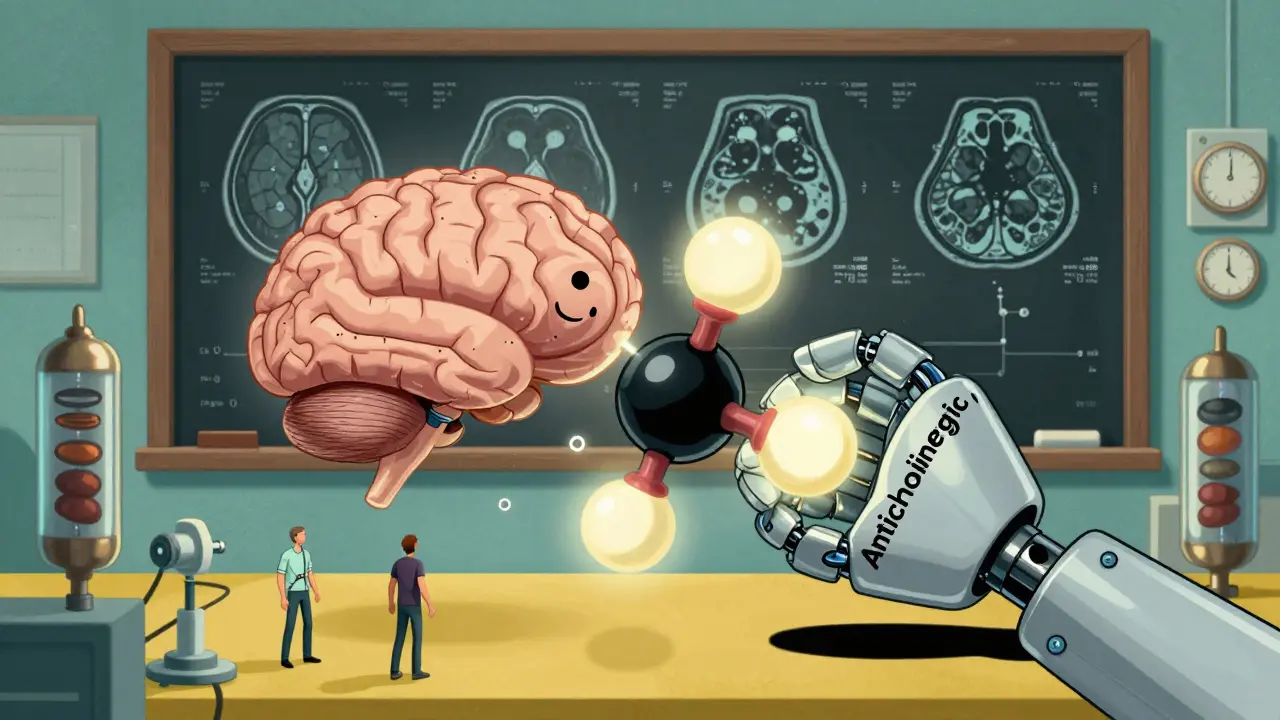
Anticholinergics are medications that block a key brain chemical called acetylcholine. They’ve been used for decades to treat everything from overactive bladder and Parkinson’s to allergies and depression. But behind their effectiveness lies a quiet, growing danger-especially for people over 65. These drugs don’t just reduce bladder spasms or ease tremors. They also slowly erode memory, shrink brain tissue, and leave patients parched-sometimes so badly they can’t speak or swallow without sipping water constantly. The real question isn’t whether they work. It’s whether the cost is worth it.
What Anticholinergics Do to Your Brain
Anticholinergics work by blocking muscarinic receptors, especially the M1 subtype, which is critical for memory and focus. When these receptors are shut down, your brain’s ability to form new memories and retrieve old ones takes a hit. It’s not just forgetfulness. Studies using MRI scans show that people taking high-ACB (Anticholinergic Cognitive Burden) drugs lose brain volume faster. On average, users of medications with an ACB score of 2 or 3 lose 0.5% to 1.2% more brain tissue per year than non-users. That’s not a small difference-it’s the kind of change you’d normally see over a decade of natural aging, happening in just a few years.
Brain imaging from the Alzheimer’s Disease Neuroimaging Initiative (ADNI) found that long-term users had 10-15% larger ventricles (the fluid-filled spaces in the brain) and 8-14% less glucose metabolism in the hippocampus, the area responsible for memory. These aren’t theoretical findings. They’re measurable, visible changes on scans. People on these drugs also scored 23-32% worse on memory recall tests and 18-27% worse on executive function tasks like planning and problem-solving. And the worse the score, the longer they’d been on the drug.
The Dry Mouth Problem You Can’t Ignore
One of the most common side effects? Dry mouth. It’s not just annoying. It’s debilitating. About 82% of users on Drugs.com report constant thirst, difficulty speaking, or trouble swallowing. One patient described needing 2-3 liters of water daily just to get through a conversation. Another said their tongue felt like sandpaper, making eating painful.
This happens because anticholinergics shut down salivary glands. No acetylcholine means no signal to produce saliva. Over time, this isn’t just uncomfortable-it increases the risk of cavities, gum disease, and even choking. Some patients stop eating because they can’t swallow food without sipping constantly. It’s a hidden quality-of-life killer that doctors often overlook.

Not All Anticholinergics Are the Same
Here’s the critical point: not all drugs in this class are created equal. The ACB scale rates them from 0 (no effect) to 3 (high risk). A score of 3 means serious cognitive risk. Drugs like diphenhydramine (Benadryl), oxybutynin, and amitriptyline all score 3. They’re the worst offenders.
But others? Much safer. Glycopyrrolate, trospium, tolterodine, and darifenacin all score 1 or lower. They still treat overactive bladder-but with far less brain impact. A 2020 study in Nature Scientific Reports showed oxybutynin (ACB 2-3) caused 28% more cognitive decline than tolterodine (ACB 1-2). That’s not a small gap. It’s the difference between noticing a slight memory lapse and struggling to remember your grandchild’s name.
Even more telling: mirabegron, a non-anticholinergic drug for overactive bladder, works just as well as oxybutynin-with zero cognitive side effects. So why do so many people still get the risky version? Cost. Generic oxybutynin costs $15 a month. Mirabegron? $350. For many, the price difference is too steep to ignore-even if the brain damage isn’t.
Who’s Most at Risk?
Older adults are the most vulnerable. About 20-30% of Americans over 65 are on at least one anticholinergic medication, according to Harvard Medical School. The American Geriatrics Society says this is dangerous. Their 2023 Beers Criteria update lists 56 medications as potentially inappropriate for seniors, including diphenhydramine, oxybutynin, and amitriptyline. They don’t just warn-they urge doctors to avoid them entirely for chronic use.
But the damage isn’t limited to seniors. A 2019 meta-analysis found that even healthy young adults given scopolamine (ACB 3) showed severe declines in attention, working memory, and episodic memory. The brain doesn’t care if you’re 25 or 75. If you block acetylcholine, memory suffers.
And the risk grows with time. A 2015 BMJ study of 48,000 people found that taking high-ACB drugs for three or more years nearly doubled the risk of dementia. For those on them for five years? The risk jumped even higher. Some patients saw their MMSE scores-used to measure cognitive function-drop from 29/30 to 22/30 after just five years on amitriptyline. That’s not aging. That’s drug-induced decline.

What Can You Do?
If you or a loved one is on one of these drugs, don’t panic-but do act. First, check the ACB score. Many pharmacies now list it on the label. If it’s 2 or 3, ask your doctor: Is this the only option? Are there safer alternatives?
For overactive bladder: Try mirabegron. Or behavioral changes-bladder training, pelvic floor exercises, timed voiding. These work. They’re just slower and require effort.
For sleep or allergies: Skip diphenhydramine. Use non-sedating antihistamines like loratadine or cetirizine. They don’t cross the blood-brain barrier. No brain fog. No dry mouth.
For depression or nerve pain: Amitriptyline is often prescribed, but SSRIs or SNRIs are just as effective for many and don’t carry the same cognitive risk. Ask if switching is possible.
For dry mouth: Sugar-free gum or lozenges can boost saliva by 30-40%. Prescription options like pilocarpine (5mg three times a day) can increase flow by 50-70%. Saliva substitutes like Xerolube help too. But none of this fixes the root problem-blocking acetylcholine.
The Bigger Picture
Prescription rates for high-risk anticholinergics are dropping. Oxybutynin prescriptions in Medicare patients fell 32% from 2015 to 2022. Mirabegron use rose over 300% in the same period. That’s progress. But it’s not enough.
Doctors still miss the signs. A 2020 JAMA Internal Medicine study found only 32% of primary care physicians could correctly identify high-ACB drugs in patient cases. Many still think, “It’s just dry mouth. It’s not serious.” But the science says otherwise. Brain shrinkage. Memory loss. Higher dementia risk. These aren’t side effects. They’re predictable outcomes.
New drugs are coming. Trospium chloride XR has 70% less brain penetration than oxybutynin. Karuna’s xanomeline targets M1 receptors more precisely, cutting dry mouth risk by 40%. AI tools like MedAware are now flagging risky prescriptions before they’re written. These are steps forward.
But the biggest change has to come from patients asking: Is this drug worth the cost? If your memory is fading, your mouth is dry, and you’re taking a drug for a condition that has alternatives-then it’s time to have the conversation. Your brain will thank you.
Can anticholinergics cause dementia?
Yes, long-term use of high-ACB anticholinergics (like diphenhydramine, oxybutynin, or amitriptyline) is linked to a doubled risk of dementia after three or more years of use, according to a 2015 BMJ study of over 48,000 patients. Brain imaging shows these drugs accelerate brain shrinkage and reduce activity in memory centers. The American Geriatrics Society now advises avoiding these drugs in older adults for chronic conditions.
Which anticholinergics are safest for the brain?
Drugs with an ACB score of 1 or lower are much safer. These include glycopyrrolate, trospium, tolterodine, darifenacin, fesoterodine, tiotropium, and ipratropium. For overactive bladder, mirabegron is a non-anticholinergic alternative that works just as well without affecting memory. Always check the ACB score on your prescription-many pharmacies list it now.
Why do anticholinergics cause dry mouth?
Anticholinergics block acetylcholine, the chemical that tells your salivary glands to produce saliva. Without that signal, your mouth dries out. This isn’t temporary-it can last as long as you take the drug. Up to 82% of users report severe dry mouth, which increases risks of tooth decay, difficulty swallowing, and even choking. Sugar-free gum or prescription pilocarpine can help, but only if the drug is still necessary.
Is there a way to reverse the brain damage from anticholinergics?
There’s no proven way to reverse brain shrinkage once it’s occurred. But stopping the drug can stop further damage. Some patients report slight memory improvement after discontinuing high-ACB medications, especially if they’ve been on them for less than five years. The key is early intervention. The longer you’re on it, the less likely recovery is. Always consult your doctor before stopping any medication.
What should I ask my doctor about my anticholinergic medication?
Ask: What’s the ACB score of this drug? Are there non-anticholinergic alternatives? How long do I really need to take it? Could behavioral therapy or a different medication work just as well? Request a cognitive check-up (like the MoCA test) every six months if you’re over 65. And if you’re on it for more than a year, ask if deprescribing is an option.
Namrata Goyal
March 24, 2026 AT 10:55Actually, I think this whole 'brain shrinkage' thing is overblown. My grandma took Benadryl for 15 years and she still remembers my birthday. Also, 'ACB score'? Sounds like a made-up metric by pharma-hating nerds. Dry mouth? Maybe drink less water. Or stop complaining. I’ve had dry mouth since I started eating pizza. Not the drug’s fault.
Jefferson Moratin
March 24, 2026 AT 19:12The underlying epistemological framework here is fundamentally flawed. To reduce neurodegenerative risk to a single pharmacological variable-ACB-is to commit the fallacy of reification. The brain is not a static organ; it is a dynamic, adaptive system. The observed volume loss may reflect synaptic pruning, not pathology. Furthermore, the correlation between anticholinergic use and dementia does not establish causality. Confounding variables-such as polypharmacy, socioeconomic status, and preclinical neurodegeneration-are systematically unaccounted for in these studies.
It is not the drug that is dangerous. It is the reductionist narrative that pathologizes normal aging.
Caroline Dennis
March 25, 2026 AT 13:35As a geriatric nurse practitioner, I see this daily. Patients on high-ACB meds often present with 'mild cognitive impairment'-but it’s iatrogenic. We switch them to mirabegron or tolterodine, and within 3 months, their MoCA scores improve by 3–5 points. Dry mouth? Yes. But not worth losing executive function.
Pro tip: Always check the ACB score on the Rx label. If it’s not listed, call the pharmacy. Most now have it in their system. And if your doc pushes back? Ask for the Beers Criteria. They’ll have to cite it.
Kenneth Jones
March 27, 2026 AT 00:17Kevin Y.
March 27, 2026 AT 10:08Thank you for this incredibly well-researched and compassionate breakdown. I’ve shared this with my aging parents, and we’ve already scheduled a med review with their PCP. The ACB score clarification was eye-opening-we had no idea diphenhydramine was a 3. We’ve switched to loratadine and are trying pelvic floor therapy for bladder issues. Small changes, big impact.
For anyone reading: Don’t be afraid to ask your doctor, 'Is this the safest option?' You’d be surprised how often they don’t know either.
Raphael Schwartz
March 28, 2026 AT 08:36Grace Kusta Nasralla
March 28, 2026 AT 17:26I’ve felt this. Not just the dry mouth. The fog. The way I’d walk into a room and forget why. I thought it was menopause. Or stress. Or aging. Then I read about ACB. Stopped amitriptyline. Took 4 months. Now I remember my own phone number. It wasn’t a miracle. It was a reversal.
They told me it was 'normal.' But normal doesn’t feel like losing yourself.
Korn Deno
March 29, 2026 AT 11:32Aaron Sims
March 29, 2026 AT 21:01Oh wow. Another 'science' article. Let me guess-next you’ll tell me that vaccines cause autism, or that the moon landing was fake.
ACB score? Who funds this? The FDA? The NIH? Or the $350 mirabegron company? I’ve been on oxybutynin since 2010. I’m 71. I remember Nixon’s resignation. I remember my first car. My brain’s fine. You’re just selling fear. And maybe a $350 pill.
P.S. My tongue’s dry? I gargle salt water. Problem solved. No drug changes needed.
Stephen Alabi
March 30, 2026 AT 22:01While the article presents a compelling narrative, it is methodologically unsound. The studies cited rely on observational cohorts with inadequate adjustment for confounders such as baseline cognitive status, duration of comorbidities, and concomitant medication use. Furthermore, the ACB scale itself lacks standardization across institutions and is not validated as a predictive biomarker for dementia.
The assertion that 'brain shrinkage' is directly attributable to anticholinergics ignores the fact that neurodegenerative processes begin decades before clinical manifestation. To attribute causality to a single drug class is both scientifically indefensible and ethically irresponsible. The true danger lies in the oversimplification of complex neurobiology for marketing purposes.