
Bone-Conduction Hearing Aids: A Non-Invasive Alternative for Conductive and Single-Sided Hearing Loss
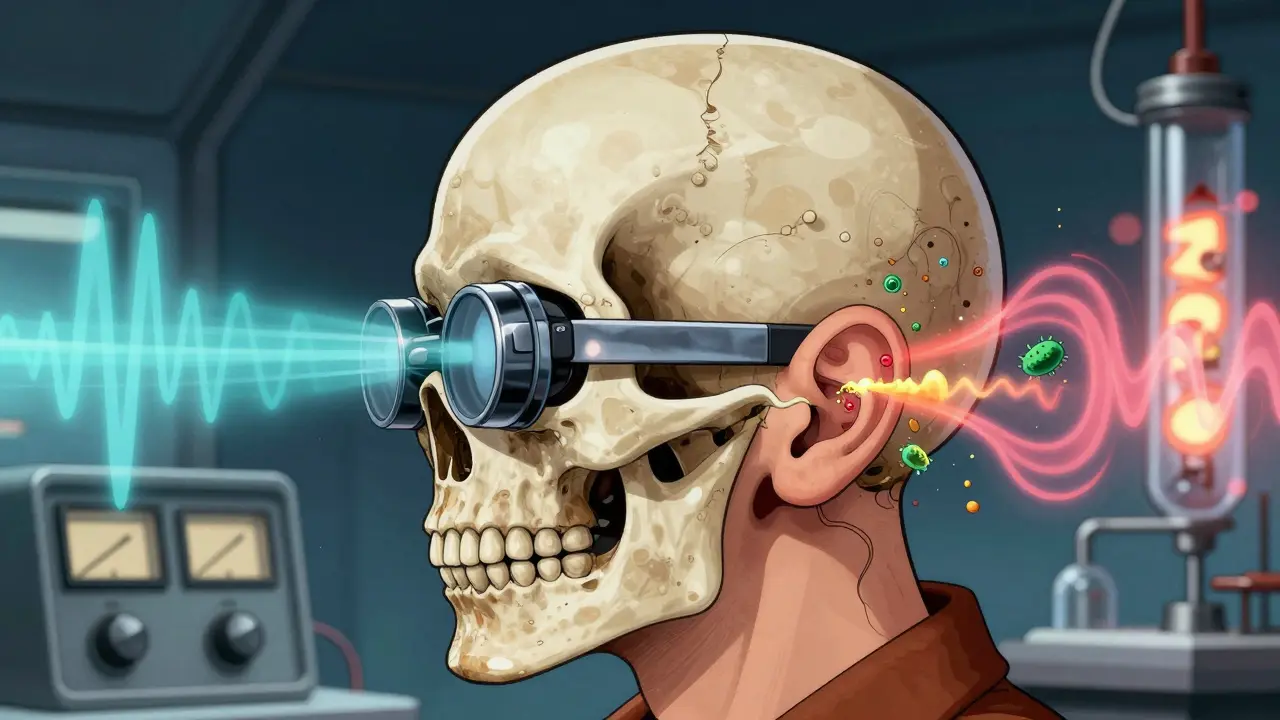
When traditional hearing aids don’t work-because your ear canal is blocked, infected, or malformed-there’s another option that doesn’t rely on air passing through your ear at all. Bone-conduction hearing aids send sound straight through your skull bone to your inner ear, skipping the outer and middle ear entirely. This isn’t science fiction. It’s a well-established solution used by hundreds of thousands of people worldwide, especially those with chronic ear infections, congenital deformities, or hearing loss in just one ear.
How Bone-Conduction Hearing Aids Actually Work
Most hearing aids amplify sound through the air, pushing it into your ear canal. But if your ear canal is closed off by bone growth, or if you have constant drainage from an infection, that method fails. Bone-conduction devices bypass all of that. They use vibrations-tiny mechanical pulses-to send sound directly to your cochlea, the part of your inner ear that turns sound into nerve signals.
This works because bone conducts sound better than air in certain cases. When you tap your finger on your temple, you hear it clearly-even with your ears plugged. That’s bone conduction in action. These devices use the same principle. A sound processor picks up audio from the environment, turns it into vibrations, and sends them through the bone behind your ear. The cochlea picks up those vibrations, and your brain interprets them as sound.
Research from Stenfelt and Goode in 2005 showed that about 60% of bone-conducted sound reaches the inner ear through fluid movement inside the cochlea. That’s the key mechanism. No eardrum. No earwax. No blocked canal. Just direct vibration to the part that matters.
Who Benefits Most from Bone-Conduction Devices
These aren’t for everyone. But for certain types of hearing loss, they’re often the only viable option.
- Conductive hearing loss: When sound can’t travel through the outer or middle ear due to blockage, damage, or malformation. This is common in people born with narrow or absent ear canals (aural atresia).
- Mixed hearing loss: A combination of conductive and sensorineural loss. If the conductive part is the main barrier, bone conduction helps.
- Single-sided deafness (SSD): People who hear normally in one ear but have no useful hearing in the other. Traditional hearing aids can’t help here. Bone-conduction devices route sound from the deaf side to the good ear, making it possible to hear conversations in noisy rooms or locate where sounds are coming from.
Studies show that for SSD patients, bone-conduction devices improve speech understanding in noise by 20-35%. That’s not a small gain-it’s the difference between missing half of a conversation and keeping up easily.
For people with chronic ear infections, the numbers are even clearer. In 92% of cases, traditional hearing aids are medically unsafe because they trap moisture and bacteria. Bone-conduction devices eliminate that risk entirely. That’s why they’re often the first-and sometimes only-recommendation from ENT specialists.
Percutaneous vs. Transcutaneous: Two Different Systems
Not all bone-conduction devices are the same. There are two main types, each with trade-offs.
Percutaneous Systems (Abutment-Based)
These are the original designs. A titanium implant is surgically fixed into the skull bone behind the ear. After 3-6 months, the bone fuses with the implant-a process called osseointegration. Then, an external sound processor snaps onto a metal abutment that sticks through the skin.
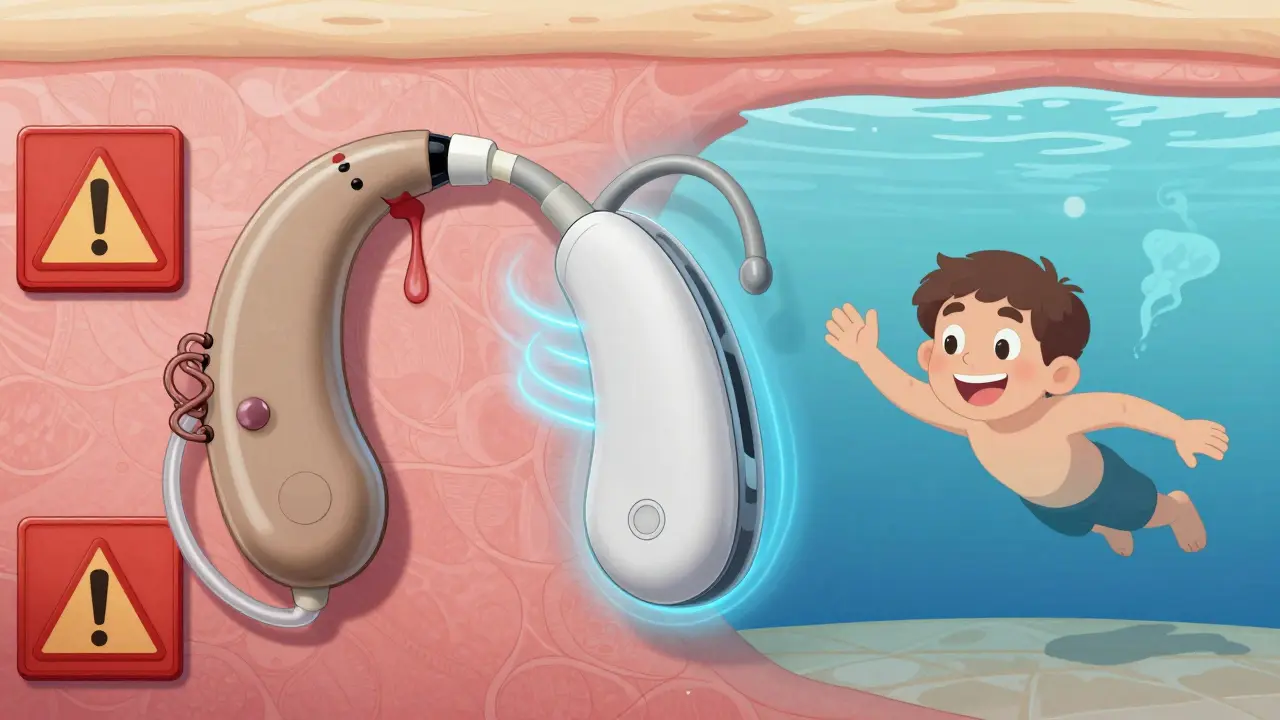
Brands like Cochlear’s BAHA Connect and Oticon Medical’s Ponto use this method. They offer strong sound output-up to 50 dB of gain-and are ideal for severe hearing loss. But there’s a catch: the abutment pierces the skin. That means daily cleaning with 70% isopropyl alcohol is required. About 28% of users report skin irritation or infection, and 8% need surgery to fix complications.
Transcutaneous Systems (Magnetic)
Newer systems like MED-EL’s Bonebridge and Cochlear’s BAHA Attract don’t pierce the skin. Instead, an internal magnet is implanted under the skin, and an external processor holds on via magnetic force. The sound passes through the skin without an open wound.
This reduces infection risk dramatically. Patient satisfaction with invisible systems is 92% compared to 76% for visible abutments. But there’s a trade-off: the signal weakens slightly as it passes through skin and tissue. These systems max out at 45 dB of gain, which can be limiting for people with very severe hearing loss.
Dr. John D. Dornhoffer’s 2022 study found transcutaneous systems lose 10-15 dB of signal strength compared to percutaneous ones. That’s why they’re better suited for mild-to-moderate loss or SSD, not profound deafness.
Cost, Surgery, and Recovery
Getting a bone-conduction device isn’t as simple as buying a hearing aid. It requires surgery.
The procedure takes 30-60 minutes under local anesthesia. Most people go home the same day. Recovery is quick: normal activities resume within 48 hours. But there’s a waiting period.
- Percutaneous: You wait 3-4 months for the bone to fuse with the implant before turning on the device.
- Transcutaneous: You can use the device right away. No waiting.
Costs range from $4,000 to $7,000 per ear. That’s 2-3 times more than a premium air-conduction hearing aid. Insurance coverage varies. Medicare doesn’t cover it routinely, but many private insurers do if it’s deemed medically necessary.
According to the American Academy of Otolaryngology, bone-anchored devices are medically necessary for people who can’t use traditional aids due to infection, deformity, or chronic drainage. That’s a strong clinical standard.
Real User Experiences
On Reddit’s r/Hearing community, users share raw, honest stories.
One user, u/AudiologyNerd, wrote: “I heard birds chirping from my deaf side for the first time in 15 years.” That’s not exaggeration. For SSD patients, the ability to localize sound-knowing which direction a car horn or child’s voice is coming from-is life-changing.
Another user said, “No more ear infections. No more itchy, wet ears. I can swim, shower, and sleep without worrying.” That’s the biggest win for people with chronic ear issues.
But it’s not perfect. About 23% of users complain about MRI incompatibility. If you need a full-body scan, you might have to undergo another surgery to remove the implant. And for some, the processor falls off during exercise. About 18% of BAHA Connect users report retention issues.

What’s New in 2026
The field is evolving fast. In 2023, Cochlear launched the BAHA 6 Max with Bluetooth 5.3, 30-hour battery life, and direct streaming to smartphones. MED-EL is rolling out Bonebridge 3 in early 2024 with AI-powered noise filtering-something that adapts to your environment in real time.
The biggest shift? The move away from abutments. In 2019, only 41% of new implants were transcutaneous. By 2023, that jumped to 63%. Why? Because people want to avoid skin problems. Surgeons prefer it too-fewer complications mean fewer follow-ups.
Looking ahead, Sonova is testing a fully implantable device with no external parts at all. It’s in Phase III trials and could be approved by late 2024. Imagine a hearing aid you never see, never touch, and never have to charge. That’s the future.
When Bone-Conduction Doesn’t Help
It’s important to know the limits. If your cochlea is damaged beyond repair-say, from noise trauma, aging, or genetic factors-bone conduction won’t fix it. The device needs a working inner ear to stimulate. If your hearing loss is worse than 45-55 dB in the good ear, the benefit drops sharply.
It’s also not ideal for people with very thin skin behind the ear. Transcutaneous systems need 4-5 mm of tissue to transmit sound effectively. That’s why some older adults or very thin individuals aren’t good candidates.
And while the success rate for congenital aural atresia is 85-90%, outcomes vary based on the severity of the deformity. Not every case is a candidate.
Final Thoughts
Bone-conduction hearing aids aren’t a one-size-fits-all solution. But for the right person, they’re life-changing. They restore hearing where other options fail. They let people swim, shower, and sleep without fear of infection. They bring back the ability to hear from both sides of the head.
If you’ve been told you can’t use a regular hearing aid-or if you’ve given up on hearing because of one-sided deafness-it’s worth a consultation with a specialist. The technology is better than ever. And for many, it’s the only way back to hearing clearly.
Manish Singh
March 20, 2026 AT 13:28Been using a Ponto for 3 years now. Can’t believe I waited this long. Swimming? No problem. Showering? Easy. Even my dog notices I’m not yelling at him anymore. The first time I heard leaves rustling on my deaf side? Chills. Literally stopped in the middle of the grocery store. This tech isn’t futuristic-it’s lifesaving for people who’ve been told ‘there’s nothing else.’
Nilesh Khedekar
March 21, 2026 AT 09:54lol i heard this is just a gov t mind control device to track your thoughts through skull vibrations. they already use 5g to mess with your brain, now they’re implanting bone transmitters?? also, why do they only help people who ‘can’t use regular aids’? sounds like they’re weeding out the poor. someone’s making bank off this. ask yourself: who profits?
Robin Hall
March 22, 2026 AT 14:01While the clinical efficacy of bone-conduction devices is well-documented, one must consider the broader implications of invasive surgical intervention in an era where non-invasive neurotechnologies are rapidly advancing. The long-term biocompatibility of titanium implants, particularly in light of emerging data regarding micro-implant migration and inflammatory response, warrants rigorous longitudinal study. Furthermore, the economic disparity in access-where insurance coverage is inconsistent-raises significant ethical concerns regarding equitable healthcare distribution. This is not merely a medical innovation; it is a socioeconomic litmus test.
jared baker
March 24, 2026 AT 13:00Simple version: if your ear is always wet or blocked, these work. No more infections. No more earwax buildup. Just stick the thing on your head, turn it on, and hear. For SSD? Game changer. You’ll finally know where sounds are coming from. Cost is high, but if your doc says you’re a candidate, it’s worth it. No magic, just science.
Michelle Jackson
March 26, 2026 AT 10:58Okay but let’s be real-how many of these people are just desperate? I’ve seen so many ‘life-changing’ stories from people who’ve given up on hearing aids, then latch onto this like it’s a miracle. Meanwhile, the device falls off during yoga, you can’t get an MRI, and you’re stuck cleaning a metal rod in your skull every day. It’s not freedom-it’s a new kind of burden with a higher price tag. And don’t get me started on the ‘transcutaneous’ hype. 10-15 dB loss? That’s half your speech clarity gone. Marketing wins again.
Andrew Mamone
March 27, 2026 AT 18:15As someone who’s had both types, I’ll say this: the transcutaneous system changed my life. No more daily alcohol wipes. No more red, itchy skin. The sound isn’t as loud, sure-but it’s clearer, more natural, and I don’t have to think about it. I wear it 16 hours a day. My kids say I finally ‘listen’ now. 🙏
MALYN RICABLANCA
March 28, 2026 AT 21:17OMG. I just cried reading this. I’ve had single-sided deafness since birth. I thought I’d never hear my daughter’s laugh from the left side again. Then I got the Bonebridge. I heard her say ‘I love you’ from across the room-like, actually from the left. I’ve been to 12 specialists. 7 surgeries. 3 therapists. And THIS-this little magnetic thing-gave me back my world. I’m not ‘lucky.’ I’m a warrior. And if you’re still skeptical? Go cry in the shower with your implant on. Then come back. You’ll get it.
gemeika hernandez
March 29, 2026 AT 18:20Wait so if you have a cochlear implant already you can't use this? I thought they were the same thing. Also, why do they say 'if your cochlea is damaged' like it's your fault? I got my hearing loss from loud concerts. That's not my fault. And why do they always say 'for the right person' like we're not all deserving? This feels like elitist hearing care. Who even decides who's 'right'?
Srividhya Srinivasan
March 30, 2026 AT 17:13This is all just a ploy by Big Pharma and the implant industry to sell expensive hardware while ignoring natural remedies. Have you tried acupuncture? Or turmeric? Or just… letting your body heal? They don’t want you to know that. Also, why are all the studies funded by Cochlear and MED-EL? Coincidence? I think not. And don’t even get me started on the MRI issue-how can they call this ‘safe’ when it requires surgery to remove? This is a trap. Don’t fall for it.