
Common Pharmacist Concerns About Generic Substitution: Perspectives from the Front Lines
When a pharmacist hands you a pill in a plain white bottle instead of the branded box you expected, it’s not just a cost-saving move-it’s a clinical decision loaded with hidden tensions. Generic substitution is one of the most powerful tools for cutting drug costs, but behind the counter, pharmacists face real, daily challenges that don’t show up in government reports. They’re caught between policy, patient distrust, physician hesitation, and the sheer weight of explaining why a $4 pill can be just as effective as a $40 one.
Why Generic Substitution Exists
The system was built to save money. Since the 1984 Hatch-Waxman Act, the FDA has allowed generic drugs to enter the market after proving they’re bioequivalent to brand-name versions. That means the active ingredient is identical, and the body absorbs it within 80% to 125% of the original. On average, studies show a 3.5% difference in absorption between brand and generic versions-statistically insignificant for most patients. The result? Generics cost about 21% less on average, and they make up over 90% of prescriptions filled in the U.S. today. But here’s the catch: just because a drug is approved doesn’t mean patients, doctors, or even pharmacists fully trust it. The gap between science and perception is wide, and pharmacists are the ones who have to bridge it-often in under three minutes.Patient Resistance: More Than Just Price
Most pharmacists will tell you the biggest hurdle isn’t policy or paperwork-it’s patient fear. Patients don’t always understand that a generic isn’t a cheaper version of the same drug. They think it’s a different drug. A 2015 survey found that 64% of patients had never heard from their doctor that a generic was an option. So when they pick up their prescription and see a different color, shape, or label, panic sets in. One woman in Austin told her pharmacist she refused the generic because it "looked like something from a discount store." Another man with high blood pressure insisted his brand-name pill "worked better"-even though his blood pressure numbers hadn’t changed in six months. The problem is worse for chronic conditions. While 82% of patients accept generics for short-term issues like infections, only 72% accept them for long-term conditions like diabetes or epilepsy. Why? Because they’re scared. They’ve heard stories. They’ve seen packaging changes. They don’t trust foreign manufacturers. And frankly, they’ve been left in the dark. Pharmacists often spend extra time walking patients through the FDA’s bioequivalence standards. Some use a simple analogy: "Think of it like two identical cars-one made in Michigan, one in Ohio. Same engine, same fuel efficiency. Just different factory." But not everyone buys it.Clinical Gray Zones: When Substitution Gets Risky
Not all drugs are created equal. Pharmacists worry most about drugs with a narrow therapeutic index (NTI)-medications where even a tiny change in blood levels can cause harm. Examples include warfarin, levothyroxine, phenytoin, and lithium. For these, the 3.5% average absorption difference doesn’t feel so small. One pharmacist in Ohio reported a patient who switched from a brand-name anti-seizure drug to a generic and had a seizure within two weeks. The patient wasn’t non-adherent. The dose was correct. But the slight difference in absorption-combined with the patient’s sensitivity-was enough to tip the balance. The case made national headlines. The FDA says generics are safe. But pharmacists know: science doesn’t always match lived experience. That’s why many pharmacists avoid substituting NTI drugs unless the prescriber explicitly allows it. Some states even require written consent before substituting these drugs. In Texas, pharmacists must document every substitution for levothyroxine. In California, they can’t substitute without checking the prescriber’s notes. Biosimilars add another layer. These are complex biologic drugs-like insulin or rheumatoid arthritis treatments-that aren’t exact copies of the original. They’re similar, but not identical. The FDA requires extra testing, and pharmacists have to be extra careful. Many pharmacists say they’re still waiting for clearer guidelines before routinely substituting them.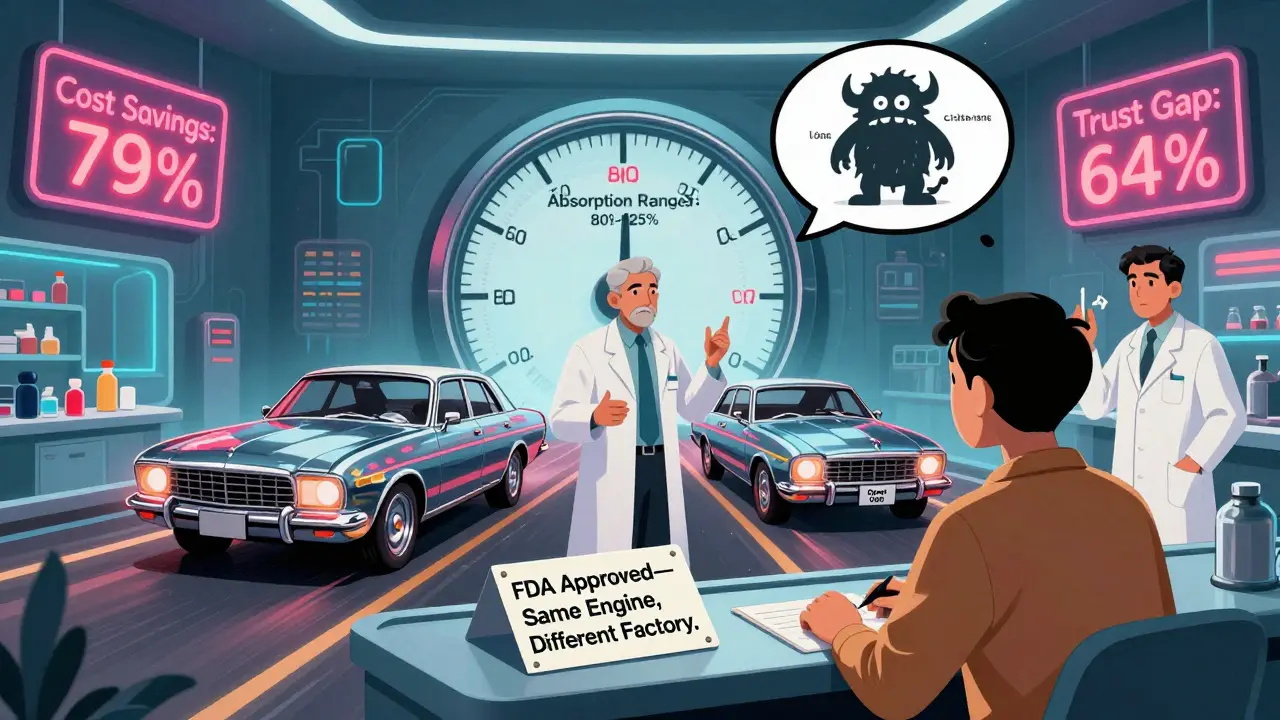
The Education Burden: Who’s Responsible?
Here’s the uncomfortable truth: pharmacists are the ones left explaining a system no one else talks about. A 2015 study found that while 79% of patients were told substitution was possible, only 38% were told they could refuse it. Only 52% were told about the price difference. That means most people walk into the pharmacy thinking they’re being forced into a cheaper option-not offered a choice. Pharmacists don’t have time to give 10-minute lectures. But they still have to answer questions like: "Why is this one blue and the last one was yellow?" or "Is this made in China?" or "Will it work as well?" Some pharmacists carry laminated cards with simple graphics showing FDA equivalence standards. Others use the phrase: "The FDA requires generics to work the same way, in the same amount of time, as the brand. If it didn’t, it wouldn’t be approved." But the real solution? Doctors need to talk about this before the patient even gets to the pharmacy. When a physician says, "I’m switching you to a generic because it’s just as effective and will save you money," patient acceptance jumps by 40%. Yet 55% of patients say they never discussed cost with their doctor.The System Is Broken-But Pharmacists Are Still Making It Work
Despite all this, pharmacists recommend generics for 96% of eligible prescriptions. They know the science. They’ve seen the data. They’ve watched patients save hundreds of dollars a year. But they’re tired. Tired of being the middleman between a broken system and confused patients. Tired of being blamed when a patient thinks their generic "didn’t work." Tired of having to educate not just patients-but also doctors who don’t understand the difference between bioequivalence and clinical equivalence. In urban pharmacies, substitution flows smoothly. In rural areas, it’s harder. Patients travel farther. They see fewer specialists. They’re more likely to distrust unfamiliar brands. And pharmacists there often have fewer resources to explain it all.
What Needs to Change
The fix isn’t complicated:- Doctors need to initiate the conversation. Not the pharmacist.
- Patients need to be told they can refuse substitution-and how to do it.
- Pharmacists need better tools: quick-reference guides, patient handouts, and time to explain.
- States need consistent rules for NTI drugs and biosimilars.
What Patients Should Know
If you’re handed a generic:- You have the right to refuse it.
- You have the right to ask why it’s different.
- You have the right to ask your doctor if substitution is safe for your condition.
Can pharmacists substitute any generic drug without asking?
No. State laws vary, but most require pharmacists to follow specific rules. For example, substitutions for drugs with a narrow therapeutic index (like warfarin or levothyroxine) often require prescriber approval. Some states also require patient consent or documentation. Pharmacists can’t substitute if the prescription says "Do Not Substitute" or "Dispense as Written."
Are generic drugs really as good as brand-name drugs?
Yes-for the vast majority of medications. The FDA requires generics to have the same active ingredient, strength, dosage form, and route of administration as the brand. They must also prove bioequivalence, meaning they deliver the same amount of drug into the bloodstream within a very tight range (80-125%). Studies show no meaningful difference in effectiveness for over 90% of generic drugs. However, for a small number of drugs with a narrow therapeutic index, even small differences can matter, and some patients may respond differently.
Why do generic pills look different from brand-name ones?
By law, generics can’t look exactly like the brand-name version because of trademark rules. So they’re made with different colors, shapes, or markings. These differences are purely cosmetic and don’t affect how the drug works. But patients often mistake these changes for a different medication, which can lead to confusion or refusal to take it.
Can I ask my pharmacist to give me the brand-name drug instead?
Yes. You have the right to refuse a generic substitution and ask for the brand-name drug. However, your insurance may require you to pay the full price difference. Some pharmacists will help you find a cheaper brand option or suggest patient assistance programs if cost is a concern.
Why do some doctors seem hesitant about generic substitution?
Some doctors worry about drugs with a narrow therapeutic index, where even small changes in blood levels could cause harm. Others have seen patients experience issues after switching, even if the science says it should be fine. And some are simply unfamiliar with how the generic approval process works. Education and clear communication between prescribers and pharmacists can help reduce this hesitation.
Freddy King
February 20, 2026 AT 20:30Let’s cut through the noise: bioequivalence is a statistical mirage. The FDA’s 80-125% window isn’t a safety buffer-it’s a legal loophole dressed up as science. You’re telling me that a 25% swing in bioavailability is "insignificant"? That’s like saying two rockets with 25% different thrust profiles are "functionally identical."
And don’t get me started on the manufacturing variance. Generic factories in India and China aren’t held to the same GMP scrutiny as US plants. The data’s cherry-picked. The audits? Paper-thin. This isn’t pharmacology-it’s regulatory theater.
Meanwhile, pharmacists are the human buffer between systemic incompetence and patients who just want to not die. We’ve all seen the cases: the guy on warfarin whose INR spiked after a generic switch, the epileptic who seized because his phenytoin levels dropped 18%. No one talks about those. The system rewards volume, not vigilance.
And yet, we keep pretending this is a cost-saving win. It’s not. It’s a risk-shifting scheme. The savings go to insurers. The liability? It lands on the pharmacist’s head when the patient’s kidney fails or their seizure returns. The real question isn’t whether generics work-it’s who’s accountable when they don’t.
And no, the "two cars from Michigan and Ohio" analogy is garbage. One car has a recall notice. The other doesn’t. You don’t tell someone to drive the recalled one because "it’s cheaper."
Jayanta Boruah
February 21, 2026 AT 13:47It is of paramount importance to acknowledge that the structural underpinnings of pharmaceutical substitution are not merely economic, but epistemological in nature. The ontological distinction between bioequivalence and clinical equivalence remains grossly underappreciated by the lay public, and indeed, by many members of the medical profession. The regulatory framework, while ostensibly grounded in empirical rigor, operates upon a reductionist paradigm that fails to account for inter-individual pharmacokinetic variance. The assertion that a 3.5% mean absorption difference is statistically insignificant is, in truth, a profound misrepresentation of clinical reality. For patients with comorbidities, polypharmacy, or genetic polymorphisms in cytochrome P450 enzymes, such deviations may precipitate therapeutic failure or iatrogenic harm. The burden of education, as rightly noted, is disproportionately borne by pharmacists, who, despite their professional autonomy, are constrained by institutional inertia and reimbursement structures that incentivize expediency over deliberation. The solution, therefore, must be systemic: prescriber education, standardized patient counseling protocols, and mandatory documentation for narrow therapeutic index agents. Without such measures, the current paradigm remains ethically untenable.
James Roberts
February 23, 2026 AT 05:54Okay, let’s be real here-pharmacists are the unsung heroes of healthcare, and we’re all pretending this system isn’t a dumpster fire wrapped in a brochure.
Yes, generics work for 90% of people. But that 10%? The one with the seizure disorder, the thyroid issue, the heart condition? They’re not just "a statistic." They’re someone’s mom, dad, sibling. And yet, we let insurance companies dictate their medication based on a spreadsheet.
And the worst part? The doctors don’t say a word. They just check "substitute" on the prescription form and walk away. Meanwhile, the pharmacist is stuck explaining why the pill is blue now instead of white-and no, it’s not because it’s "made in a basement in Moldova."
Also, the "FDA says it’s fine" argument? That’s like saying "the moon landing was real" to someone who’s never seen a photo. Trust isn’t built on regulatory seals-it’s built on transparency, time, and communication. And we’ve given pharmacists none of those.
So yeah, let’s stop pretending this is about saving money. It’s about saving *profit*. And the cost? Patient trust. And that’s not something you can price in cents per pill.
Danielle Gerrish
February 25, 2026 AT 00:50I’ve been a pharmacist for 22 years, and let me tell you-this isn’t just about pills. It’s about fear. It’s about the 78-year-old widow who cried because her husband’s "real" heart pill looked "like a child’s medicine." It’s about the teenager with epilepsy whose mom switched him to a generic because "it was cheaper," and then called me at 2 a.m. because he had a seizure.
I’ve had patients throw their meds on the counter and scream, "I don’t care what the FDA says-I know my body!" And you know what? They’re right. Their body *is* different. Science doesn’t capture that. Algorithms don’t capture that. But we do.
I keep laminated cards with before-and-after blood levels. I draw little faces. I say, "This is your body. This is the drug. This is what we’re trying to match." And still, half the time, they leave unconvinced.
And the doctors? They don’t even mention it. I’ve had patients ask me, "Why didn’t my doctor say this was coming?" And I have to say, "I don’t know. I wish they had."
This isn’t about cost. It’s about dignity. And we’ve stripped that away in the name of efficiency. Someone needs to fix this. Not me. Not the pharmacy. Someone higher up.
And if you’re reading this and you’re a doctor-please, for the love of everything holy, talk to your patients before they get to the counter. Just one sentence. "I’m switching you to a generic because it’s the same drug, just cheaper." It’s not hard. But no one does it. And I’m tired.
Liam Crean
February 25, 2026 AT 11:08I’ve seen this play out in rural clinics. The pharmacy is 45 minutes away. The patient doesn’t have a car. They don’t have internet. They don’t know what "bioequivalence" means. They just know the pill looks different. And if they refuse, they don’t get it at all.
So they take it. And sometimes, it works. Sometimes, it doesn’t. And no one’s there to explain why.
I’m not against generics. I’m against the silence. The system assumes people are informed. They’re not. They’re just trying to survive.
Pharmacists are doing the work of three people. And they’re not being paid for it. Or thanked. Or even asked if they’re okay.
Just… stop making them the emotional laborers of the healthcare system. It’s not sustainable.
madison winter
February 25, 2026 AT 20:29Everyone’s so focused on the science, but nobody’s talking about the emotional toll. The pharmacist isn’t just handing out pills-they’re handing out reassurance, trauma responses, and existential dread wrapped in a plastic bag.
I’ve had patients ask me, "Is this the same one my grandma took?" and I had to say, "I don’t know. I wasn’t born then."
Generics aren’t the problem. The lack of continuity is. The lack of trust is. The lack of *conversation* is.
And honestly? The fact that we’ve turned healthcare into a cost-cutting puzzle instead of a human relationship… that’s the real crisis.
Ellen Spiers
February 27, 2026 AT 06:00The assertion that bioequivalence equates to clinical equivalence is a fallacy predicated upon an oversimplification of pharmacokinetic variability. The FDA’s acceptance criteria of 80–125% AUC and Cmax are statistically arbitrary and clinically indefensible for pharmacologically sensitive populations. Moreover, the absence of mandatory therapeutic drug monitoring (TDM) for NTI agents in generic substitution protocols constitutes a systemic failure of risk mitigation.
Furthermore, the assertion that "96% of eligible prescriptions" are substituted ignores the confounding variable of prescriber coercion. Many patients are not given a meaningful choice; they are presented with substitution as a fait accompli. This undermines autonomy and violates the ethical principle of informed consent.
It is also noteworthy that the majority of generic manufacturers operate under regulatory regimes with inferior audit transparency. The lack of harmonization between international GMP standards and U.S. expectations introduces unquantifiable risk.
Until prescribers are mandated to document rationale for substitution, and until TDM is universally integrated into the dispensing protocol for NTI drugs, this system remains ethically and clinically untenable.
Marie Crick
February 27, 2026 AT 12:32If you’re taking a generic and it doesn’t work, you’re weak. Your body’s just not tough enough. Stop whining. The FDA says it’s fine. So it’s fine. Get over it.
Tommy Chapman
March 1, 2026 AT 09:14Let’s be real-this whole "generic" thing is just Big Pharma’s way of keeping you broke while they make billions off the brand names. The FDA? They’re bought. The doctors? They don’t care. But the pharmacist? They’re the only one who actually gives a damn. And you know what? I respect that.
But here’s the truth: if you’re gonna let some factory in Bangladesh make your heart pill, don’t come crying when it doesn’t work. You chose the cheap route. Now deal with it.
And for the love of God, stop making pharmacists your therapists. They’re not here to hold your hand while you cry over a blue pill. They’re here to count pills. That’s it.
Scott Dunne
March 3, 2026 AT 07:18It is regrettable that the discourse surrounding generic substitution has devolved into an emotional appeal rather than a reasoned examination of pharmacoeconomic policy. The notion that pharmacists bear undue burden is, while superficially sympathetic, an abdication of collective responsibility. The prescriber holds the ultimate authority in the therapeutic decision-making chain. The pharmacist is a dispensing agent, not a clinical arbiter. To elevate their role beyond procedural compliance is to misalign the structure of professional accountability.
Moreover, the assertion that patients are "left in the dark" ignores the existence of standardized labeling protocols, FDA-mandated patient information leaflets, and digital pharmacy portals. The onus for comprehension lies with the patient, not the system.
That said, for drugs with a narrow therapeutic index, a precautionary approach is warranted. However, blanket restrictions based on anecdotal reports undermine evidence-based practice. The solution is not more paperwork-it is better education, delivered at the point of prescription, not at the point of dispensing.