
Direct-to-Consumer Generic Pharmacies: How Much You Really Save vs. Insurance
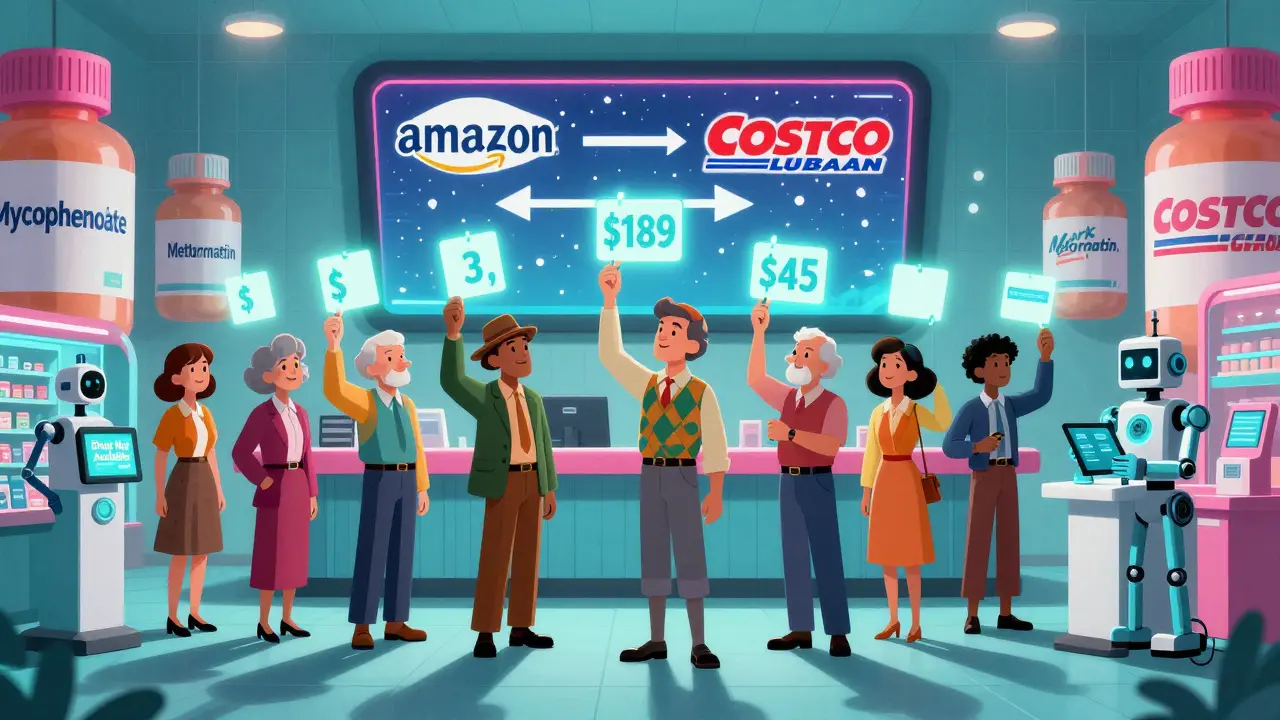
What if you could buy your monthly blood pressure pill for $3 instead of $45 - even if you have insurance? That’s not a dream. It’s happening right now through direct-to-consumer (DTC) pharmacies. But here’s the catch: sometimes, your insurance still beats the cash price. And sometimes, the drug you need just isn’t available online at all.
Why DTC Pharmacies Even Exist
For years, pharmacy benefit managers (PBMs) controlled how much you paid for generics. They negotiated rebates with drugmakers, passed on confusing pricing to pharmacies, and left patients stuck with high out-of-pocket costs - even for drugs that cost pennies to make. By 2020, frustration boiled over. That’s when Mark Cuban and Dr. Alex Oshmyansky launched Mark Cuban Cost Plus Drug Company a direct-to-consumer pharmacy that sells generic medications at cost plus a 15% markup, bypassing traditional pharmacy benefit managers. Amazon, Costco, Walmart, and Health Warehouse followed. These companies cut out the middlemen and sold drugs straight to you, cash-only.The Real Savings: Expensive vs. Common Generics
Not all generics are created equal. The biggest savings come from the most expensive ones - the drugs that used to cost hundreds a month. A 2024 study in the Journal of General Internal Medicine looked at the 50 most costly generic drugs covered by Medicare Part D. For those, DTC pharmacies saved patients an average of $231 per prescription compared to retail prices. That’s a 76% drop. Some pills dropped from $800 to $189. That’s life-changing for people paying out of pocket. But for common generics - like metformin, lisinopril, or atorvastatin - the savings are tiny. About $19 per prescription. That’s still 75% cheaper than retail, but if your insurance copay is $10, you’re not saving much. In fact, you might be paying more.Who’s Cheapest? It Depends on the Drug
There’s no single winner. The same study found:- For expensive generics: Amazon had the lowest price on 47% of drugs, Mark Cuban Cost Plus Drug Company on 26%, Health Warehouse on 14%, and Costco on 13%.
- For common generics: Costco led with 31%, Amazon at 27%, Walmart at 20%, Health Warehouse at 12%, and Mark Cuban at just 10%.
The Hidden Problem: Missing Drugs
Here’s where things get dangerous. One in five of the most expensive generics aren’t available on any major DTC pharmacy. That includes drugs for rare conditions, complex chronic illnesses, and even some neurological treatments. A 2023 CVS Health study looked at 79 neurological generics. Mark Cuban’s pharmacy carried only 33 of them. And of those 33, only two were cheaper than what insured patients paid through their PBM. If you take a drug like gabapentin, pregabalin, or levetiracetam - common for epilepsy or nerve pain - you might find it at your local pharmacy for $12 with insurance, but not available online at all. That forces you back into the insurance system, even if you wanted to go cash-only.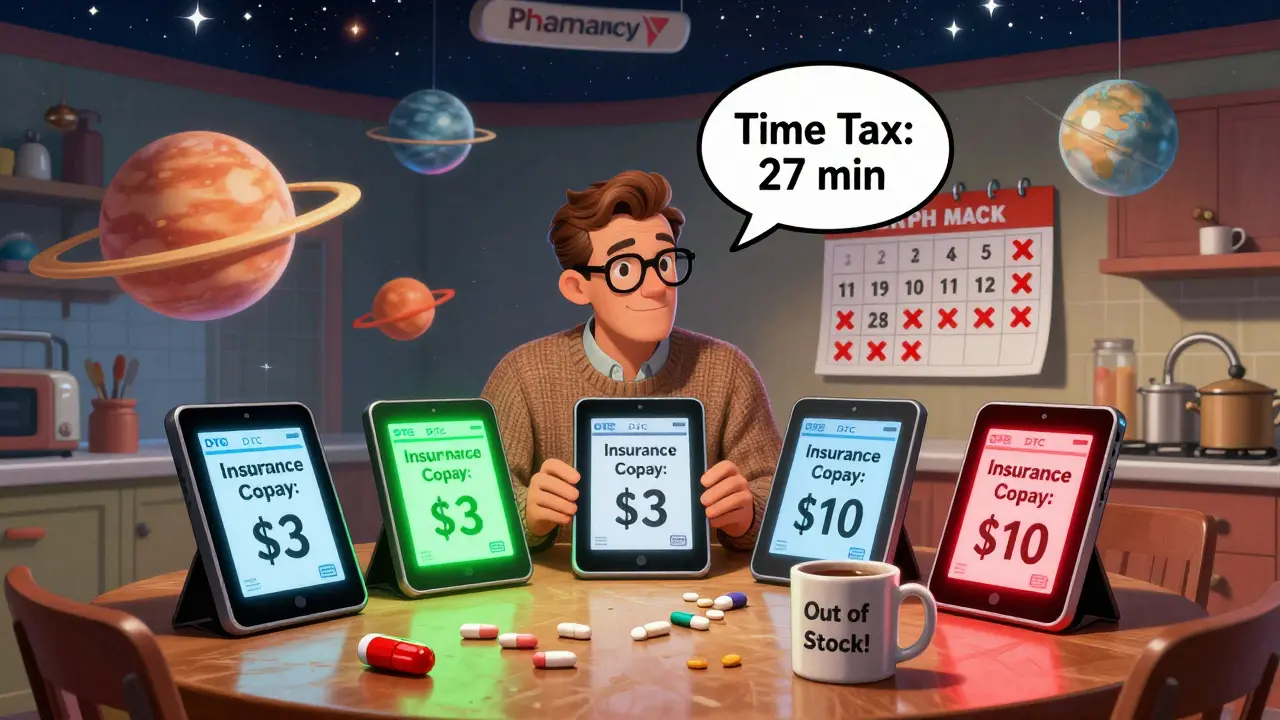
Insurance Isn’t Always the Enemy
Many people assume insurance = expensive. But that’s outdated. The USC Schaeffer Center found that 90% of commonly prescribed generics in Medicare Part D cost less than $20 for a 30-day supply at Costco - even without insurance. And many insurance plans now have $0 or $5 copays for generics. If your plan covers your drug and you have a pharmacy nearby, you might not need to shop online at all. Plus, insurance often includes delivery, refill reminders, and pharmacist consultations. DTC pharmacies? You’re on your own. No one calls to warn you about interactions. No one checks if you’re doubling up on the same drug.The Time Tax: How Much Effort Is Really Worth It?
Let’s say you take five different generic medications. To save money, you’d need to:- Check Amazon for each one
- Check Mark Cuban Cost Plus Drug Company
- Check Costco
- Check Walmart
- Check Health Warehouse
- Compare those prices to your insurance copay
- Order from the best option
- Wait 2-5 days for shipping
- Repeat next month
What Experts Say
Dr. Hatim Lalani, lead author of the 2024 study, put it bluntly: “Patients and prescribers have to shop around. It’s time-consuming, and there’s no simple tool to help.” He’s right. No app, no website, no insurance portal gives you a real-time comparison of every pharmacy - DTC, retail, and insurance-based - in one place. CVS Health’s research team warned that if everyone switched to DTC pharmacies, total out-of-pocket spending could actually rise by $82 million across commercial plans. Why? Because for many drugs, insurance still wins. And when patients can’t find their drug online, they’re forced to pay full retail price - which is often higher than their insurance copay.
Who Should Use DTC Pharmacies?
You’re a good candidate if:- You’re uninsured or underinsured
- You’re on one or two expensive generics (like mycophenolate, cyclosporine, or everolimus)
- You’re willing to spend 15-30 minutes a month comparing prices
- You don’t need immediate access - shipping is fine
- Your drug isn’t available online (check first!)
- Your insurance copay is $10 or less
- You take five or more meds - the time cost isn’t worth it
- You need your meds today
The Bottom Line
DTC pharmacies aren’t a magic fix. They’re a tool - useful for some, useless for others. For expensive generics, they can save you hundreds. For common ones, they barely move the needle. And for many drugs, they don’t even carry them. The real win isn’t choosing between insurance and DTC. It’s knowing which drug you’re taking, where it’s cheapest, and whether the time you’ll spend shopping is worth the savings. Right now, that’s on you. No app, no insurer, no pharmacy chain will do it for you. But if you’re smart, you can save real money - without giving up your health.Are DTC pharmacies safe to use?
Yes, if you use reputable ones like Amazon Pharmacy, Costco, Walmart, Health Warehouse, or Mark Cuban Cost Plus Drug Company. These are licensed pharmacies that follow FDA and state regulations. Avoid random websites that don’t require a prescription or look unprofessional. Always check for a valid pharmacy license number on their website.
Can I use DTC pharmacies if I have Medicare?
You can, but it’s complicated. Medicare Part D doesn’t cover purchases from DTC pharmacies, so you won’t get credit toward your deductible or out-of-pocket maximum. But if your drug is cheaper cash than your Part D copay, you can still buy it and pay out of pocket. Just don’t expect it to help you reach catastrophic coverage faster.
Do DTC pharmacies accept coupons or discount cards?
No. DTC pharmacies operate on cash-only pricing. GoodRx, SingleCare, and other discount cards are designed for traditional pharmacies. You can’t stack them with DTC prices. But since DTC prices are already low, you usually don’t need them.
What if my doctor prescribes a drug not available on DTC sites?
Ask your doctor if there’s a therapeutically equivalent alternative that is available. For example, if your brand-name drug has a generic version that’s not carried online, ask if another generic in the same class works. Sometimes, switching to a different but equally effective drug can unlock savings.
Is it better to buy 90-day supplies from DTC pharmacies?
Yes - if the pharmacy offers a discount for bulk. Many DTC sites lower the per-pill cost when you buy 90-day supplies. For expensive drugs, that can mean hundreds saved over the year. But only do this if you’re sure you’ll take the medication long-term and the drug is available consistently.
Jacob Cathro
January 20, 2026 AT 15:50so like... i just spent 45 mins checking 6 sites for my lisinopril and it's STILL cheaper with my insurance at $8?? like wtf. why does this even exist if the savings are like $1? i'm not gonna play pharmacy roulette every month just to save 2 bucks. this is a scam designed to make us feel guilty for using insurance. 😤
Paul Barnes
January 22, 2026 AT 01:55The empirical data presented in the 2024 Journal of General Internal Medicine study indicates a statistically significant disparity in cost differentials between high-value and low-value generics. The marginal utility of price comparison diminishes exponentially beyond three medications, rendering the model economically irrational for polypharmacy patients.
pragya mishra
January 23, 2026 AT 09:45Why are you all making this so complicated? Just go to the nearest pharmacy and ask for the cash price. If it's cheaper than your copay, take it. If not, use insurance. No website needed. No time wasted. Stop overthinking. This is basic math. You're making it a drama.
Manoj Kumar Billigunta
January 25, 2026 AT 03:45Hey everyone, I get it - this stuff can feel overwhelming. I used to take 6 meds, and I was terrified I was overpaying. What helped me was picking just one drug at a time. I started with my blood pressure pill - checked Amazon, then Costco, then my insurance. Found out Costco was $1.50 cheaper. I switched. Next month, I did the same with my cholesterol med. Slowly, I saved $200 a year. No app, no stress. Just one step at a time. You got this.
Andy Thompson
January 26, 2026 AT 02:22MARK CUBAN IS A CRYPTO SHILL FOR BIG PHARMA!!! 🤡 They all own the DTC sites - it's a trap to get you off insurance so they can raise premiums on the rest of us! You think you're saving? Nah. You're helping them break the system. The FDA is in on it too. They don't want you to know that 80% of these drugs come from China and aren't even tested. Check the license number? LOL. They fake those too. 💀
sagar sanadi
January 27, 2026 AT 11:33Oh wow, so now we're supposed to be impressed that Amazon is selling pills cheaper? Next they'll be selling oxygen and calling it 'innovation'. Meanwhile, my grandma's gabapentin is still $12 at CVS with insurance - and she doesn't even have a smartphone. This whole thing is just tech bros pretending they care about poor people while they get rich off our desperation.
kumar kc
January 29, 2026 AT 04:04If you're too lazy to check prices, you deserve to pay more.
Thomas Varner
January 31, 2026 AT 02:17Okay, so... I checked my mycophenolate on Amazon - $189. My insurance? $820. So I switched. But then I checked Mark Cuban - $192. So I went back to Amazon. Then I checked Costco - $201. Then I checked Walmart - $205. Then I checked Health Warehouse - $190. So I went back to Amazon. Then I realized I forgot to check my copay again. So I called my pharmacy. They said it’s $175 with insurance this month. So now I’m back to insurance. I’ve spent 3 hours this week just trying to buy one pill. I miss the 90s.
thomas wall
January 31, 2026 AT 08:46It is deeply concerning that the erosion of institutional pharmacy oversight has led to a fragmented, consumer-driven model that prioritizes individual savings over systemic stability. The absence of centralized coordination risks public health outcomes, particularly among vulnerable populations who lack the cognitive bandwidth to navigate this labyrinthine pricing structure. This is not progress - it is deregulation in disguise.
Shane McGriff
January 31, 2026 AT 16:57I really appreciate this breakdown. I’m a caregiver for my dad who takes 7 meds, and I was drowning in confusion. This article made me realize we don’t need to do all of it - just the expensive ones. We switched his transplant med to Amazon and saved $400/month. We left the rest on insurance. It’s not perfect, but it’s manageable now. Thank you for not making us feel dumb for not knowing this sooner.
Art Gar
February 1, 2026 AT 23:09The notion that direct-to-consumer pharmaceutical distribution represents a net societal benefit is predicated upon a fundamental misapprehension of market dynamics. The aggregate cost-shifting to commercial insurance plans, as evidenced by CVS Health’s $82 million projection, suggests that the purported individual savings are illusory and structurally unsustainable. A rational policy framework must prioritize equitable access over consumer optimization.
Edith Brederode
February 3, 2026 AT 11:22This was so helpful! 😊 I just switched my dad’s atorvastatin to Costco and saved $12. He doesn’t even know how to use the internet, so I did it for him. I’m going to check his other meds next week. It feels good to actually help instead of just paying whatever they ask for. Thank you for writing this - it’s a small win, but it matters. 💙