
Drug Interactions Databases: Using FDA and WebMD Checkers Safely
Drug Interaction Database Simulator
Enter Your Medications
Enter up to 5 medications. Separate each with a comma.
Every year, over 1.3 million people in the U.S. end up in emergency rooms because of bad drug interactions. That’s not a small number. It’s more than the population of Austin, Texas. And here’s the scary part: nearly 40% of those cases involve combinations of medications, supplements, or even foods that were never meant to be mixed. You might think your doctor caught everything. But even the best doctors miss things-especially when you’re taking five, six, or more pills a day. That’s where drug interaction databases come in. Tools like WebMD’s checker and resources tied to FDA data can help. But they’re not magic. They’re tools. And like any tool, they work best when you know how to use them-and when you know their limits.
What You Can Actually Get from the FDA
Let’s clear up a big myth right away: the FDA is the U.S. government agency responsible for approving drugs and monitoring their safety after they hit the market. But the FDA does not run a public-facing drug interaction checker. You won’t find a button on their website that says, "Check my meds." What they do offer is far more important, though less convenient. They collect reports of adverse events through the MedWatch system. When a pharmacist, doctor, or patient reports a bad reaction-say, a heart rhythm problem after mixing a blood thinner with a new antibiotic-that report goes into a massive database. These reports help the FDA spot patterns. If 20 people report the same dangerous combo, the FDA might issue a safety alert. But that alert comes after the harm happens. It’s reactive, not predictive.
So if you’re looking for a real-time, do-it-yourself FDA checker? You won’t find one. But you can use their alerts as a warning system. Check the FDA’s Drug Safety Communications page regularly. If you’re on a new medication, search for its name + "FDA alert." You might find a notice about interactions that weren’t known when the drug was first approved. For example, the drug fedratinib was linked to thiamine deficiency in early users. That wasn’t caught in clinical trials. It was found because doctors reported cases. The FDA posted a warning. That’s how the system works.
WebMD’s Checker: Simple, Fast, But Not Perfect
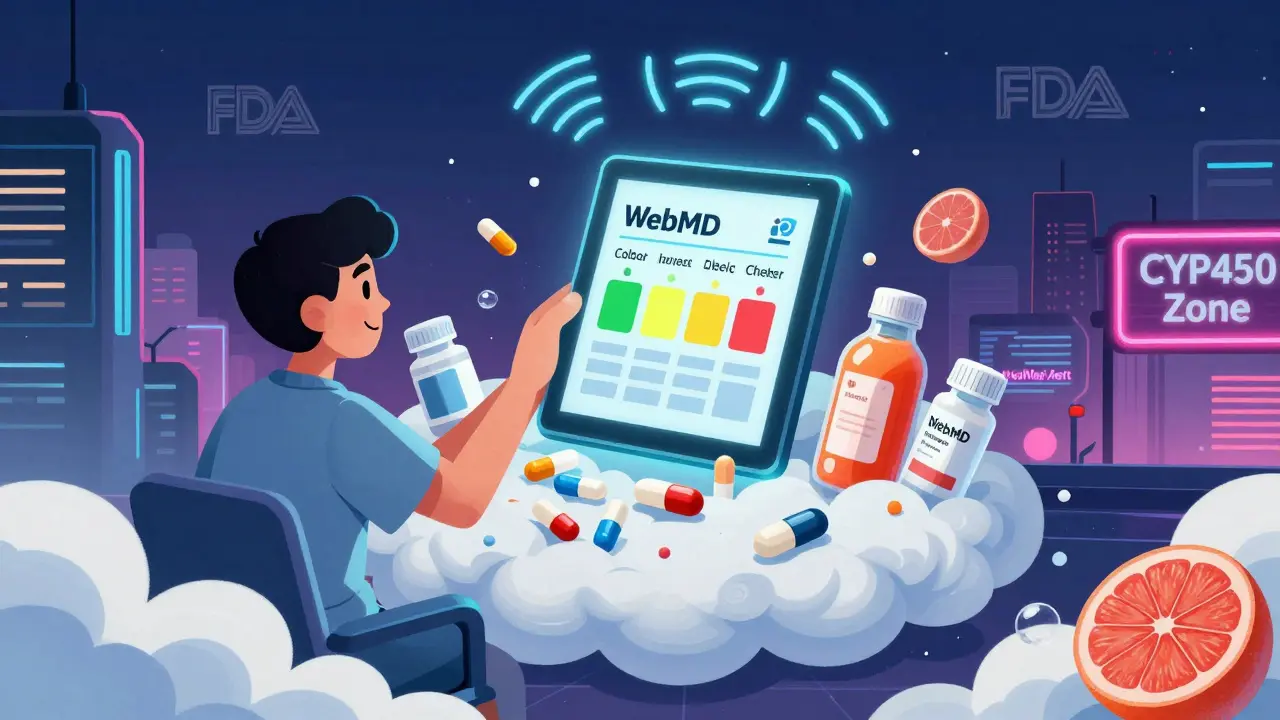
If you’ve ever Googled your meds and clicked on a blue "Drug Interaction Checker," you’ve probably landed on WebMD. It’s the most popular tool for regular people. Why? Because it’s dead simple. Type in your medications-no login, no sign-up, no fees. Hit "Check Interactions," and in under three seconds, you get a color-coded list: green for safe, yellow for moderate, red for serious. It even checks food and drink interactions. Like, "Can I drink grapefruit juice with my statin?" (Spoiler: No.)
WebMD’s checker covers over 10,000 drugs, 1,200 supplements, and dozens of common foods. It’s updated regularly-its last major update in September 2023 added alerts for new herbal interactions. It’s great for a quick sanity check. If you’re about to start a new antibiotic and you’re also taking a sleep aid, WebMD will tell you they can cause dizziness or confusion. That’s useful. But here’s where it falls short:
- It doesn’t explain why an interaction happens. No details on liver enzymes, kidney clearance, or protein binding.
- It misses some herbal supplements. St. John’s Wort, for example, is known to interfere with antidepressants, birth control, and blood thinners-but WebMD’s free version doesn’t always flag it reliably.
- It doesn’t account for your personal health. If you have kidney disease, your body processes drugs slower. WebMD doesn’t ask. It gives generic advice.
- A 2021 University of Florida study found that 17% of WebMD’s serotonin syndrome warnings didn’t match the original medical literature. That’s a red flag.
Real story: A Reddit user named u/MedStudent2025 reported that WebMD said warfarin and cranberry juice were safe. But their INR spiked to 6.2-a level that can cause internal bleeding. WebMD’s checker didn’t catch it. Why? Because cranberry’s effect on warfarin is unpredictable. It depends on the amount, the brand, even the time of year. That’s the kind of nuance WebMD can’t handle.
DrugBank: The Deep Dive for Serious Users
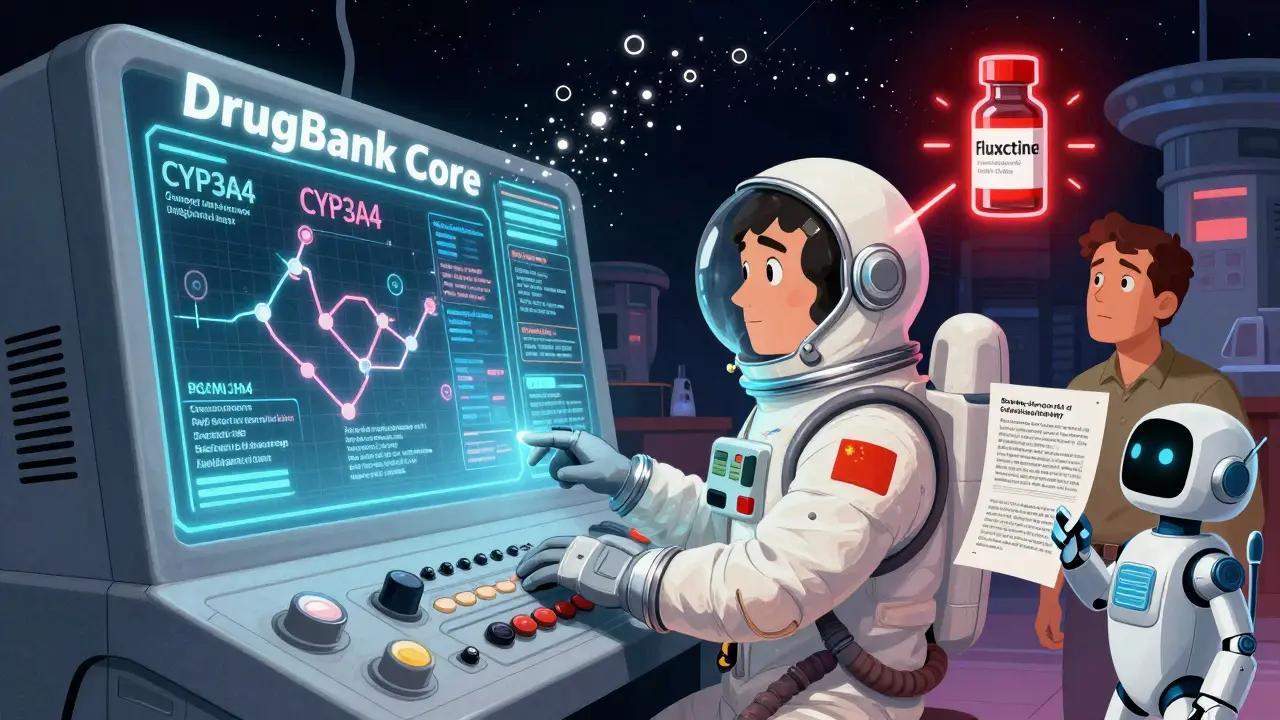
If WebMD is a flashlight, DrugBank is an MRI machine. Created by researchers at the University of Alberta, DrugBank started as a scientific database. Today, it offers a free version that lets you check up to five drugs at once. But here’s what makes it different:
- It tells you which liver enzyme (like CYP3A4 or CYP2D6) is affected.
- It explains the mechanism: Is it a pharmacokinetic interaction (how your body absorbs the drug) or pharmacodynamic (how the drugs affect your body together)?
- It gives you severity ratings (minor, moderate, major) backed by peer-reviewed studies.
- It cites the actual research papers you can look up.
For example, if you type in fluoxetine and tramadol, DrugBank will show you that both increase serotonin levels and inhibit the CYP2D6 enzyme. It will warn you of serotonin syndrome risk and give you a citation from the British Journal of Clinical Pharmacology. That’s the kind of detail a pharmacist or doctor needs. And it’s why DrugBank scores 4.8 out of 5 in clinical accuracy according to a 2022 study in JMIR Medical Informatics.
But here’s the catch: the free version doesn’t cover everything. No pharmacogenomic data (how your genes affect drug response). No food interaction details beyond basics. And it won’t tell you if you have a rare kidney condition that changes everything. Plus, if you’re not a clinician, the jargon can be overwhelming. You’ll need to Google terms like "CYP450" and "serotonin syndrome."
For hospitals and clinics? DrugBank’s enterprise API integrates with Epic, Cerner, and Allscripts EHRs. One hospital reported a 27% drop in interaction-related admissions after implementation. But that version costs $1,200 a month-way out of reach for most patients.
What No Checker Can Do
Here’s the hard truth: no database, no matter how advanced, can replace your doctor’s judgment. Why?
- They don’t know your full medical history. Did you have a stroke last year? Are you on dialysis? Are you pregnant? Checkers don’t ask.
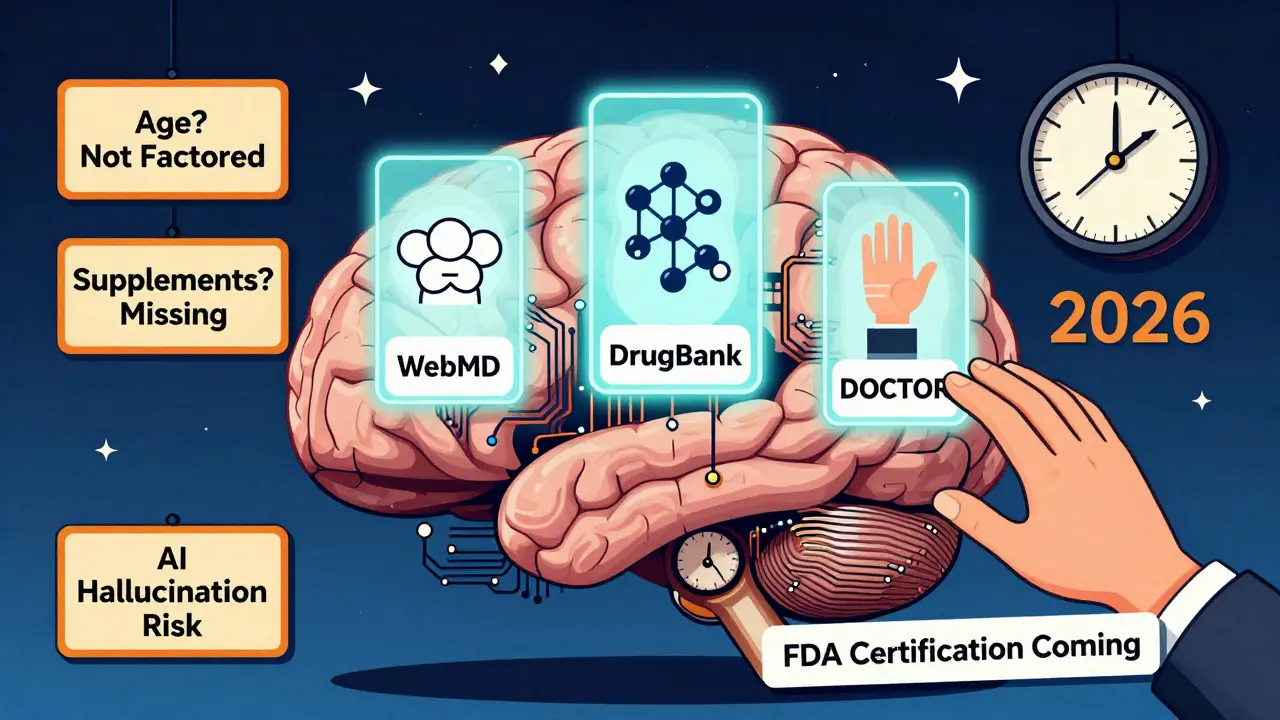
- They can’t account for age. Over 28% of people over 65 have reduced kidney function. That changes how drugs are cleared. WebMD and DrugBank don’t adjust for that.
- They lag behind new drugs. Fedratinib, approved in 2019, wasn’t in most databases until late 2020. Twelve people developed thiamine deficiency before the alert went out.
- They miss combinations involving supplements. A 2023 study found that 40% of serious interactions involved herbal products. Most free checkers barely cover them.
And here’s another hidden danger: false confidence. If a checker says "no interaction," people assume it’s safe. But that’s not how medicine works. A "minor" interaction still caused 18% of preventable hospital admissions in a 2021 study. A "moderate" one? It could kill you if you have heart failure or liver disease.
How to Use These Tools Without Getting Hurt
So how do you use them safely? Here’s a practical checklist:
- Always check both drug-drug AND drug-food interactions. Food plays a role in 40% of serious cases. Grapefruit juice, alcohol, high-sodium diets, even calcium supplements can mess with meds.
- Use WebMD for quick alerts, DrugBank for deep dives. If WebMD flags something, dig deeper with DrugBank or ask your pharmacist.
- Never trust a checker for off-label use. About 21% of prescriptions are off-label. Checkers aren’t trained for that.
- Verify with primary sources. If a checker flags a serious interaction, look up the study. Google the drug name + "interaction" + "study."
- Update your list monthly. New drugs, new supplements, new health conditions-your list changes. So should your checks.
- Always talk to your pharmacist. Pharmacists have access to real-time databases and can spot things no app can. Ask them to review your full list every time you refill a prescription.
What’s Next? AI and the Future of Drug Safety
The next wave is AI. Google’s Med-PaLM 2, tested in 2023, predicted novel drug interactions with 89% accuracy. That’s impressive. But AI hallucinates. Stanford researchers found that large language models invent fake interactions 22% of the time. That’s dangerous. The FDA is already drafting rules to fix this. By 2026, all certified drug interaction tools must show their work-explain why they flagged a risk, cite the evidence, and prove they’re not making things up.
For now, stick with the tools that have been vetted. WebMD for everyday checks. DrugBank if you’re digging deep. And always, always-double-check with a human. A pharmacist. A doctor. Someone who knows your body, not just your drug list.
Can I rely on WebMD’s drug interaction checker as my main safety tool?
No. WebMD is excellent for catching obvious, common interactions and helping you ask better questions. But it’s not a substitute for professional medical advice. It misses up to 15% of interactions, especially with supplements, new drugs, or complex health conditions. Always cross-check with your pharmacist or doctor.
Does the FDA have a public drug interaction checker?
No, the FDA does not offer a public-facing drug interaction checker. Instead, it monitors drug safety through post-market reporting systems like MedWatch. If a dangerous interaction is reported by multiple users or providers, the FDA issues a safety alert. You can find these alerts on the FDA’s website under "Drug Safety Communications."
Why do some drug interaction checkers miss interactions with supplements?
Supplements aren’t regulated like prescription drugs. Manufacturers don’t have to prove safety or interactions before selling them. So databases like WebMD and DrugBank have incomplete data. Many herbal products, especially newer ones, aren’t studied enough to be included. That’s why 40% of serious drug interactions involve supplements or foods.
Is DrugBank better than WebMD for accuracy?
Yes, for clinical accuracy, DrugBank is superior. It provides detailed mechanisms, cites peer-reviewed studies, and has a lower error rate (3% vs. WebMD’s 17% in one study). But it’s designed for professionals. WebMD is easier to use and better for patients who need a quick, simple answer. Use DrugBank to dig deeper after WebMD flags a concern.
Can I use these tools if I’m over 65?
Yes, but with caution. About 28% of older adults have reduced kidney or liver function, which changes how drugs are processed. Most checkers don’t adjust for age or organ function. So even if a checker says "safe," your body might handle the drugs differently. Always talk to your doctor or pharmacist about dosage adjustments and risks specific to your age and health.
What should I do if a checker says my drugs are safe but I feel strange?
Trust your body, not the tool. If you feel dizzy, nauseous, confused, or have an unusual heartbeat after starting a new combination-even if the checker says it’s safe-call your doctor or pharmacist immediately. Tools are based on population averages. They can’t predict how your unique biology will react.
phyllis bourassa
March 5, 2026 AT 23:11Ugh, I just had to explain this to my mom again. She’s on 7 meds, takes turmeric like it’s candy, and thinks WebMD is gospel. I showed her the FDA alert on fedratinib and she still said, ‘But it said green!’ Like, honey, if your liver’s a wreck and you’re sipping grapefruit juice like it’s orangeade, no color-coded system is gonna save you. I’ve had ER trips. I know.
Vikas Verma
March 7, 2026 AT 22:52DrugBank’s CYP450 enzyme mapping is non-negotiable for polypharmacy management. WebMD’s interface is user-friendly but lacks pharmacodynamic granularity. The 17% false-positive serotonin syndrome rate in the UF study is alarming-this is not a diagnostic tool, it’s a triage aid. Always correlate with clinical pharmacokinetics and renal clearance metrics.
Jeff Mirisola
March 8, 2026 AT 04:37Love this breakdown. Seriously. I’m a nurse and I use WebMD for quick checks with patients, then pull up DrugBank when things get messy. One guy came in with a rash after mixing St. John’s Wort and Zoloft-WebMD didn’t flag it. DrugBank did. Cited a 2020 BMJ paper. We changed his script. Saved him from a full-blown serotonin storm. Tools aren’t perfect, but they’re the best we’ve got. Just don’t let them replace your gut.
Susan Purney Mark
March 9, 2026 AT 17:38Thank you for this 🙏 I’ve been using WebMD for years but started double-checking with DrugBank after my aunt had a bad reaction to warfarin + garlic pills. No one warned her. I wish I’d known sooner. Now I print out the DrugBank reports and bring them to every appointment. My pharmacist says I’m her favorite patient 😄
Ian Kiplagat
March 11, 2026 AT 15:34Agreed. FDA doesn’t do real-time checks. It’s a post-mortem system. WebMD? Useful for laypeople. DrugBank? For when you need to know why. But always-always-ask your pharmacist. They see patterns we miss. One guy took 12 supplements. Only the pharmacist caught the kava + SSRIs combo. He was fine. Because he listened.
Amina Aminkhuslen
March 13, 2026 AT 03:34WebMD is basically a digital fortune cookie with a blue button. I once Googled ‘warfarin + cranberry’ and it said ‘no interaction.’ My INR hit 7. I almost bled out. The ER doc laughed and said, ‘That’s why we have labs.’ Don’t trust a tool that doesn’t know your kidneys are half-dead. You’re not a data point. You’re a human with a body that’s been through hell.
amber carrillo
March 14, 2026 AT 18:31I’m 68 and on 5 prescriptions. I use the checklist you gave. Monthly updates. Pharmacist review. DrugBank for anything that looks weird. WebMD for the obvious stuff. I don’t trust any tool completely. But I trust myself more now. I ask questions. I write things down. I’m not scared anymore. Just careful.
Joey Pearson
March 14, 2026 AT 22:47Yes! This is the exact reason I started asking my pharmacist to review everything every time I refill. She caught a hidden interaction between my blood pressure med and my new magnesium supplement. WebMD didn’t see it. DrugBank did. She said, ‘You’re lucky you didn’t have a stroke.’ Now I bring my whole pill organizer. She loves me. I love her. Teamwork saves lives.
Roland Silber
March 15, 2026 AT 20:32AI is coming. Med-PaLM 2 predicted a combo I’d never seen-sertraline + echinacea causing QT prolongation. But then it hallucinated a fake interaction between aspirin and kale. Real danger. The FDA’s new rules are smart. Show your work. Cite your sources. No magic. No guesswork. Just science. Until then, stick to the human experts. They’ve seen it all. And they still show up for you.