
False Advertising in Generic Drugs: Legal Risks and Compliance Rules
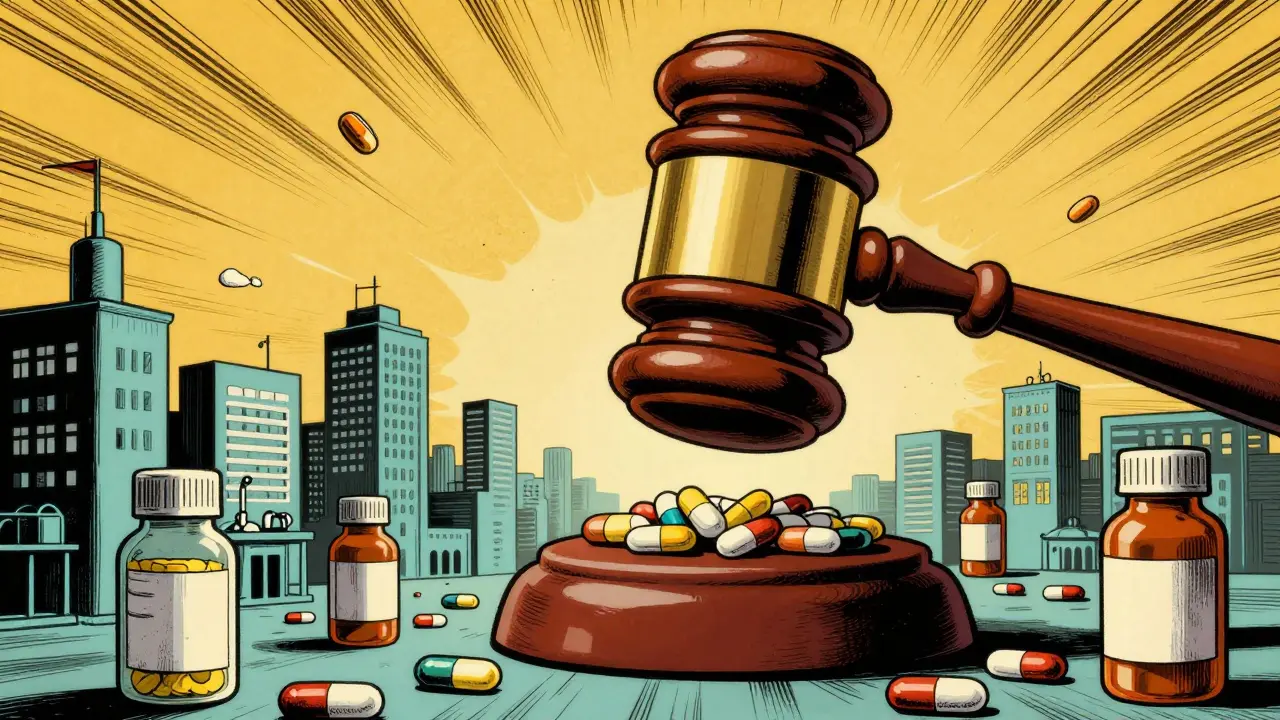
Ever wonder why some drug commercials sound like they're reading a legal disclaimer for ten minutes? It's not just for show. For companies selling generic drugs, the line between a "great deal" and a legal disaster is incredibly thin. In a market worth $140 billion, where generics make up 90% of all prescriptions, one wrong word about efficacy or safety can trigger a federal crackdown or a multimillion-dollar lawsuit. If you're marketing a generic pharmaceutical, you aren't just fighting for market share; you're navigating a minefield of federal laws and state consumer protections.
The Legal Framework Holding Generics Accountable
The rules governing how drugs are sold didn't appear overnight. They evolved from the Pure Food and Drug Act of 1906 and the 1938 Federal Food, Drug, and Cosmetic Act (FD&C Act), which was passed after the sulfanilamide tragedy proved that unregulated drugs could be lethal. For generics specifically, the Hatch-Waxman Act of 1984 changed everything by creating the Abbreviated New Drug Application (ANDA) pathway. This allowed generics to enter the market without repeating all the original clinical trials, provided they could prove they were the same as the brand-name version.
Today, the legal risks usually fall into three buckets. First, there's the FD&C Act, which focuses on whether the labeling is "misbranded." Second, the Lanham Act allows competitors to sue for false descriptions or misleading representations of a product. Finally, state laws, like New York's General Business Law § 349, allow for consumer protection lawsuits. If you get this wrong, you're not just looking at a slap on the wrist; New York can award three times the actual damages, up to $1,000 per violation.
The "Fair Balance" Rule and the 2025 Crackdown
The FDA requires a "fair balance" in every ad. This means if you spend thirty seconds talking about how a drug lowers blood pressure, you can't bury the risk of kidney failure in a tiny, fast-scrolling footer. You have to give the risks and benefits equal weight. For a long time, companies used the "adequate provision" loophole, where they'd just tell viewers to "see a doctor or visit a website" for the risks. Not anymore.
As of September 9, 2025, the federal government has effectively shut that loophole. A presidential memorandum directed the Department of Health and Human Services (HHS) to eliminate deceptive direct-to-consumer (DTC) advertising. The FDA is now requiring complete risk information to be included in the ad itself, regardless of the medium. They've already issued roughly 100 cease-and-desist letters specifically targeting ads that misrepresent how generics compare to expensive brand-name drugs.

Bioequivalence: The Technical Trap
One of the biggest legal traps for generic manufacturers is the claim of "equivalence." In the industry, the gold standard is bioequivalence. To be approved, a generic must typically be within 80-125% of the brand-name drug's pharmacokinetic parameters. However, claiming a drug is "identical" or "just as effective" in an ad without specific FDA-established therapeutic equivalence can trigger a Lanham Act lawsuit.
This is especially dangerous with "narrow therapeutic index" drugs-medications where a tiny change in dose can lead to a huge change in the patient's reaction. For example, a generic for levothyroxine (used for thyroid issues) requires extreme precision. If an ad implies that any generic is a perfect swap for any brand without physician authorization, the FDA will likely send a warning letter. Teva Pharmaceuticals learned this lesson the hard way in early 2024.
| Feature | Brand-Name Drugs | Generic Drugs |
|---|---|---|
| Risk Disclosure | Must disclose all major risks | Must disclose risks + state it is a generic |
| Superiority Claims | Allowed with clinical data | Prohibited unless head-to-head trials prove it |
| Cost Claims | Focus on value/benefit | Cannot quantify savings without FTC proof |
| Regulatory Status | "FDA Approved" | Must distinguish "Approved" vs. "Cleared" |
The High Cost of Compliance Failures
When a company cuts corners on its regulatory review, the results can be catastrophic-not just for the balance sheet, but for patients. A 2024 FDA analysis showed that 32% of patients who stopped taking their meds because of fear-mongering "health alert" ads experienced actual adverse health outcomes. This proves that false advertising isn't just a corporate legal issue; it's a public health crisis.
From a business perspective, the penalties are staggering. While some companies might face a $10,000 fine per violation, others have faced billions. GlaxoSmithKline famously paid $3 billion back in 2012 for miscommunicating drug info. To avoid this, major players now spend millions on internal controls. Some top manufacturers spend over $2 million annually just on compliance, employing teams of 15 to 25 regulatory affairs professionals to vet every single comma in a marketing brochure.

How to Build a Compliant Marketing Process
If you're running a compliance program, you can't just rely on a lawyer's quick glance. You need a multidisciplinary approach. Start by ensuring your team includes a regulatory affairs specialist with at least five years of FDA experience and a medical writer who understands the nuance between "FDA Approved" and "FDA Cleared."
Follow these technical guardrails for digital and print media:
- The 14-Point Rule: Under the 2024 "clear, conspicuous, and neutral" rule, risk information should generally appear in at least 14-point font.
- Contrast Standards: Ensure a minimum 50% contrast ratio for risk disclosures so they don't blend into the background.
- Substantiation: Never quantify cost savings (e.g., "Save 40% on your meds") unless you have rigorous data that meets FTC (Federal Trade Commission) guidelines.
- Identity Disclosure: Always clearly state, "This is a generic drug," and identify the reference listed drug it is replacing.
The Future of Pharma Ads
The tide is turning toward total transparency. With the proposed "Transparency in Drug Advertising Act" (H.R. 4582), the government wants standardized risk disclosures across all platforms. This means the "fine print" is effectively disappearing. In the coming years, expect even tighter coordination between the FDA and the FTC. Companies that invest in robust, automated review systems-similar to the $45 million infrastructure Pfizer built in 2024-will be the ones that survive the inevitable wave of litigation.
What is the difference between FDA Approved and FDA Cleared in advertising?
This is a critical legal distinction. "Approved" generally means the FDA has determined the drug is safe and effective for its intended use based on substantial evidence. "Cleared" is often used for medical devices or specific pathways where the product is substantially equivalent to another already on the market. Using "Approved" when a product is only "Cleared" can lead to Lanham Act liability for misleading consumers.
Can a generic drug claim to be better than the brand-name version?
Generally, no. Generic manufacturers are prohibited from making claims of superiority over the reference brand-name drug unless they can provide data from head-to-head clinical trials. Simply stating it is "as good as" is based on bioequivalence, but claiming it is "better" without rigorous scientific proof is a fast track to an FDA warning letter.
What happens if a company violates the Lanham Act?
The Lanham Act allows competitors to sue for false advertising. If the court finds the company misrepresented its product, it can award "treble damages," meaning the company pays three times the actual damages suffered by the competitor, plus potential attorney fees.
What is the "fair balance" requirement?
Fair balance is an FDA requirement that ensures drug advertisements do not overstate benefits or minimize risks. It requires that the side effects and contraindications be presented with similar prominence, detail, and duration as the claims of effectiveness.
Do state laws differ from FDA regulations on drug ads?
Yes. While the FDA sets the federal floor, states can have stricter rules. For example, California's Unfair Competition Law may require higher levels of substantiation for claims than federal law, and Florida's H.B. 1205 specifically bans the use of government logos in certain legal service ads related to health.