
Generic Drug User Fee Amendments: How GDUFA Laws Speed Up FDA Reviews
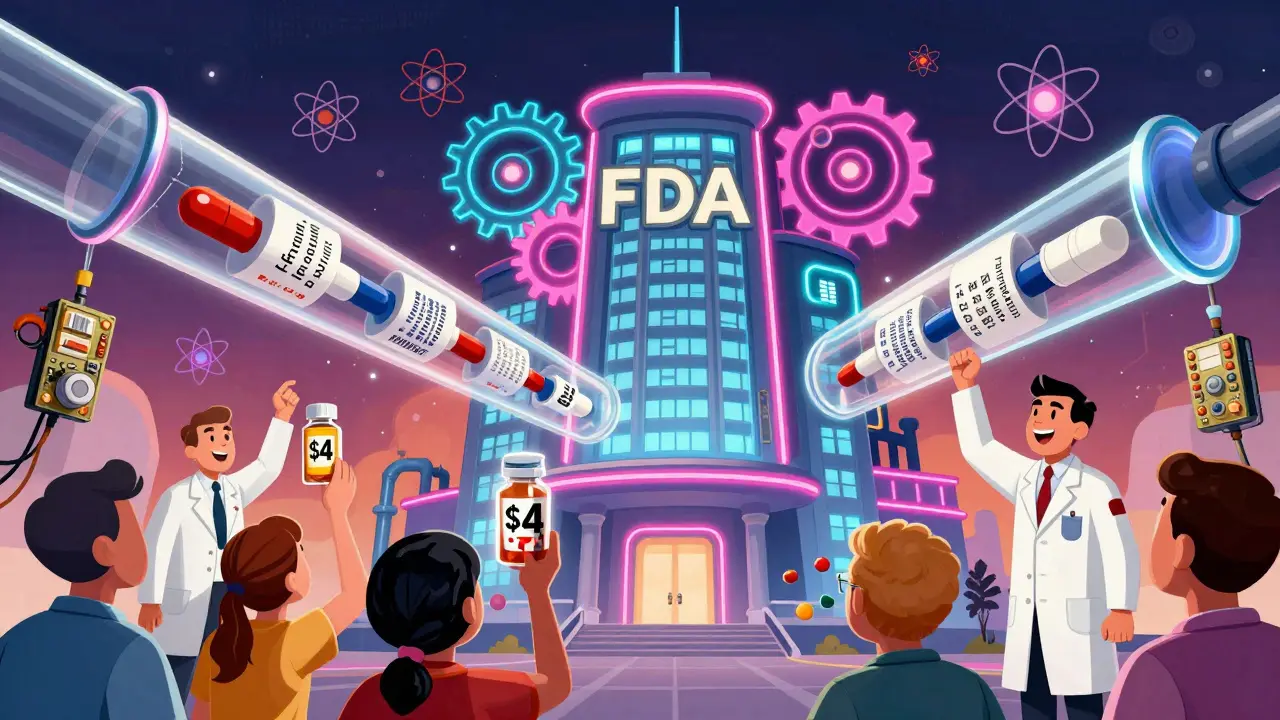
Before 2012, waiting for a generic drug to hit the market could take years. Backlogs piled up. Applications sat untouched. Patients waited longer for affordable meds. Then came the Generic Drug User Fee Amendments - or GDUFA - a law that changed everything.
What GDUFA Actually Does
GDUFA isn’t just another regulation. It’s a funding deal between the FDA and generic drug makers. In exchange for paying fees, manufacturers get faster, more predictable reviews of their applications. The FDA uses that money to hire more reviewers, inspect factories, and cut through paperwork. Without these fees, the agency would rely only on Congress for funding - a slow, unpredictable process that couldn’t keep up with demand.Before GDUFA, the FDA had over 3,000 generic drug applications waiting for review. Today, that number is under 200. The average review time dropped from over 30 months to less than 12. That’s not luck. That’s GDUFA.
How the Fees Work
Generic drug companies pay several types of fees under GDUFA:- One-time application fee for each Abbreviated New Drug Application (ANDA)
- One-time fee for each supplement to an ANDA
- One-time fee when a Drug Master File (DMF) is first used
- Annual facility fees for every manufacturing site - both domestic and foreign
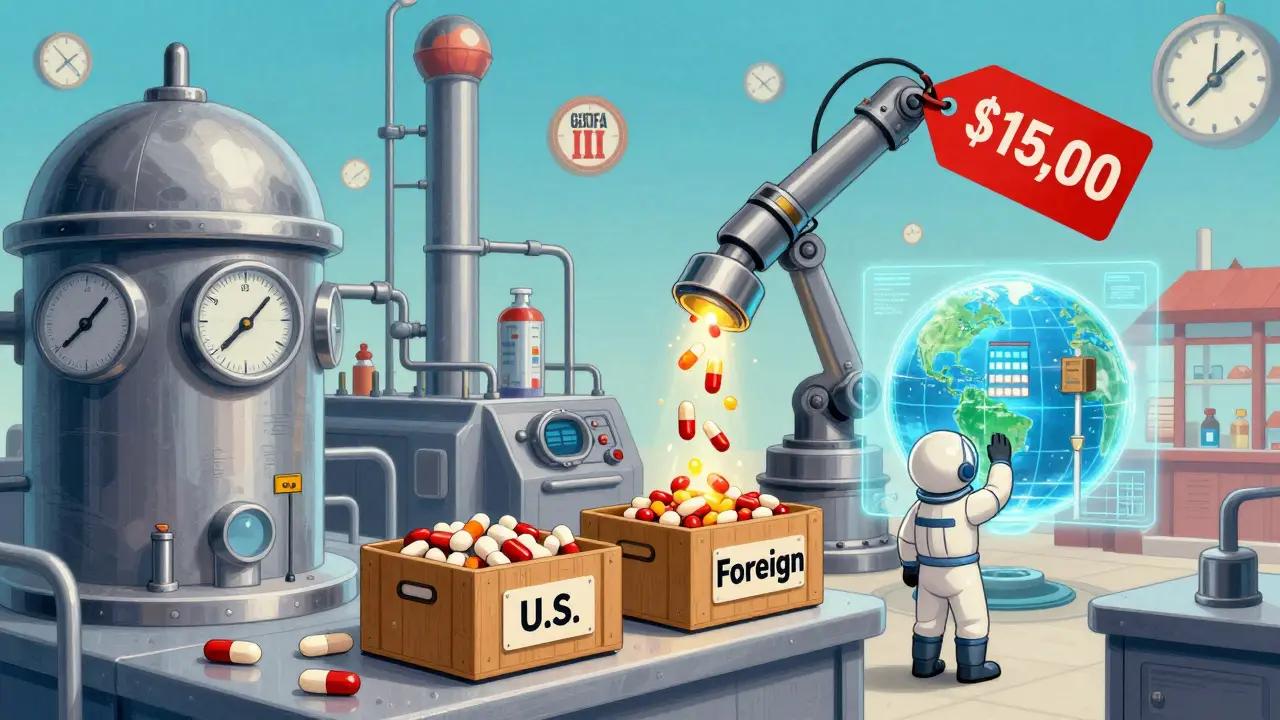
Foreign facilities pay more. A lot more. In 2024, a U.S.-based finished drug facility pays $276,780 annually. A foreign one pays $291,780. The same $15,000 gap applies to active pharmaceutical ingredient (API) sites. Why? Because inspecting factories overseas costs more - travel, translators, logistics. The FDA says it’s not punishment. It’s cost recovery.
Under GDUFA III (2023-2027), total fees collected are expected to hit $1.4 billion over five years. That money can only be spent on generic drug review. Not on cancer drugs. Not on medical devices. Just generics. The law locks it in.
Why GDUFA Was Needed
The system was broken. In 2010, the FDA had 3,400 pending ANDAs. Many were older than five years. Patients needed cheaper versions of brand-name drugs - for blood pressure, diabetes, asthma - but couldn’t get them. Meanwhile, companies sat on applications, unsure when they’d be reviewed.GDUFA fixed that by creating deadlines. The FDA now has to review 90% of ANDAs within 10 months. If they miss it, they have to explain why. That pressure changed behavior. Reviewers got better. Companies got clearer feedback. The whole system became more transparent.
How GDUFA Changed Over Time
GDUFA didn’t stay the same. It evolved.GDUFA I (2012-2017) got the program off the ground. But it had a flaw: big companies had an advantage. Paying $250,000 in annual facility fees was easier for a company with 20 products than one with just two. Smaller firms struggled. New entrants couldn’t compete.
GDUFA II (2018-2022) fixed that. It lowered fees for small businesses. It created a new category: “small business” with lower fees if they had fewer than 500 employees and fewer than 10 products. It also added a waiver for first-time applicants. That helped startups get in the door.
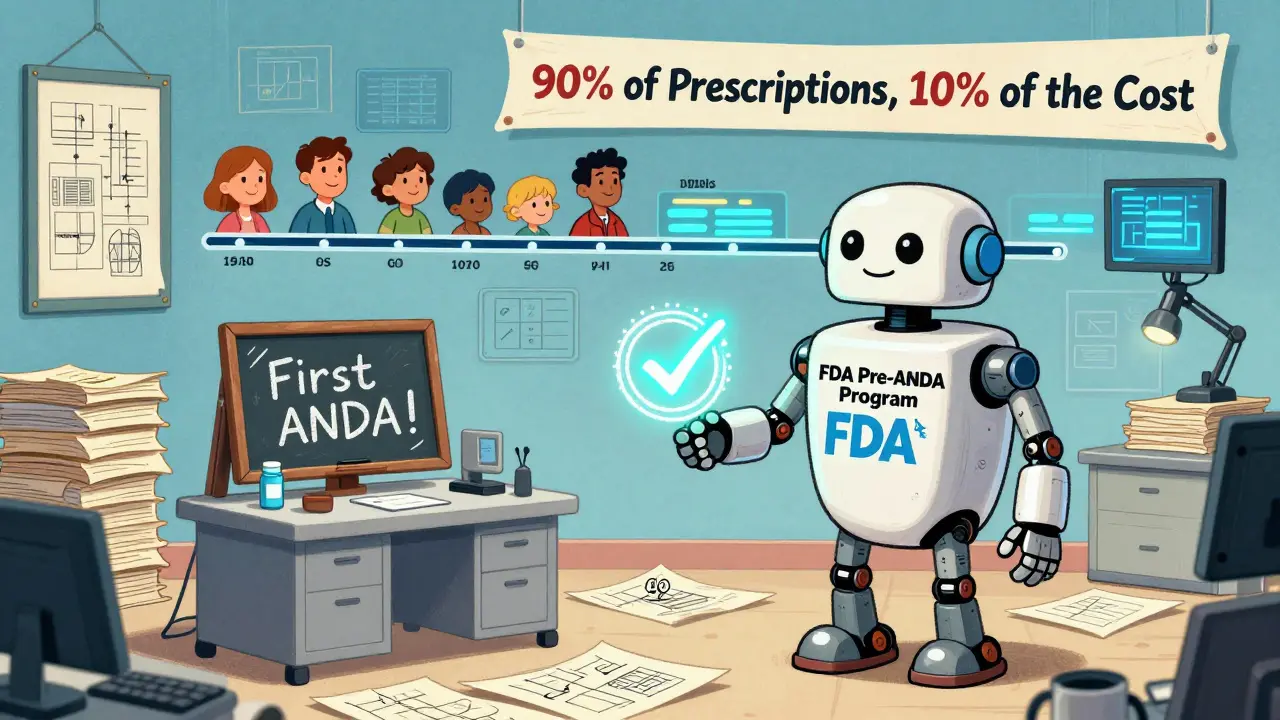
GDUFA III (2023-2027) went further. It introduced the Pre-ANDA Program - a chance for companies to meet with FDA scientists before even filing. For complex drugs like inhalers or injectables, this saved months of back-and-forth. It also created a new system for tracking facility inspections and publishing monthly reports. Transparency became a core goal.
Who Benefits?
Patients win. Generic drugs make up 90% of all prescriptions filled in the U.S. They’re cheaper - often 80-90% less than brand names. GDUFA keeps those drugs coming.Manufacturers win too. Predictable timelines mean better planning. A company can schedule production, marketing, and distribution around an expected approval date. No more guessing.
The FDA wins. They’re no longer underfunded. They have staff, tools, and deadlines. They can inspect more factories - including those in India and China, which supply over 70% of U.S. generic ingredients.
But It’s Not Perfect
Some manufacturers still complain. Small companies say even the reduced fees are too high. One startup in Ohio told the FDA: “We spend more on compliance than we make in our first year.”Foreign manufacturers argue the $15,000 surcharge is outdated. They say inspection costs haven’t risen that much. The FDA says it’s based on actual travel and labor expenses - but critics say it’s still a barrier.
And while the backlog is gone, new challenges are rising. Complex generics - like biosimilars or multi-component inhalers - still take longer to review. GDUFA III tried to fix that with the Pre-ANDA Program, but it’s still early days.
What’s Next?
GDUFA III ends in September 2027. Congress will have to renew it - again. Talks for GDUFA IV are already starting. Industry groups are pushing for:- Even lower fees for small businesses
- More digital submissions (no more paper forms)
- Clearer rules for complex generics
- More support for domestic manufacturing
The FDA says it’s ready. They’ve published their performance data for all to see. They’ve built a system that works - but it’s not done. The goal is still the same: get safe, affordable drugs to patients faster.
Why It Matters to You
You might not think about how your $4 blood pressure pill got approved. But if GDUFA didn’t exist, you’d likely be paying $40 for it. Or waiting a year longer to get it. Or not getting it at all.This law isn’t about big pharma or politics. It’s about access. About cost. About trust. It’s a quiet engine behind the 90% of prescriptions that aren’t brand names. And it’s working.
What is GDUFA?
GDUFA stands for the Generic Drug User Fee Amendments. It’s a U.S. law that lets the FDA collect fees from generic drug manufacturers to fund the review of generic drug applications. These fees help speed up approvals and improve inspections, ensuring safe, affordable generic drugs reach patients faster.
Who pays GDUFA fees?
Generic drug manufacturers pay GDUFA fees. This includes companies that make finished drug products (like pills or injections) and those that produce the active ingredients (APIs). Both U.S.-based and foreign manufacturers pay, though foreign facilities pay higher fees to cover the cost of international inspections.
How much do GDUFA fees cost?
Fees vary by type and location. In 2024, a U.S. finished drug facility pays $276,780 annually; a foreign one pays $291,780. There are also one-time fees for each ANDA application ($50,000-$150,000 depending on complexity), and fees for Drug Master Files and supplements. Small businesses get reduced rates under GDUFA III.
Does GDUFA speed up generic drug approvals?
Yes. Before GDUFA, the average review time was over 30 months. Now, the FDA aims to review 90% of applications within 10 months. The backlog of pending applications dropped from over 3,000 in 2012 to under 200 today.
Is GDUFA still active?
Yes. GDUFA III is currently in effect from October 1, 2022, through September 30, 2027. Congress must reauthorize the program before it expires, and discussions for GDUFA IV are already underway.
How does GDUFA affect drug prices?
GDUFA doesn’t directly set drug prices, but it makes generics cheaper by speeding up approval. Faster approvals mean more competitors enter the market sooner, which drives down prices. Generic drugs are typically 80-90% cheaper than brand-name versions - and GDUFA helps keep that trend going.
Kimberly Reker
January 30, 2026 AT 20:11Can’t believe how much this changed things. My grandma’s blood pressure med used to cost $120 a month. Now it’s $4. No joke. GDUFA didn’t make headlines, but it saved lives.
Sarah Blevins
February 1, 2026 AT 06:39The structural efficiency gains under GDUFA are statistically significant. The reduction in review time from 30 to 12 months represents a 60% improvement in regulatory throughput, correlating directly with increased market entry velocity for ANDAs. The fee structure, while economically rational, raises questions about equitable access for micro-manufacturers.
Jason Xin
February 1, 2026 AT 23:39Yeah, and the FDA finally stopped losing applications in a backroom somewhere. I remember when my cousin’s company waited 4 years just to get a reply. Now they get feedback in weeks. Not perfect, but way better than before.
Carolyn Whitehead
February 2, 2026 AT 15:24also i think the small biz discounts were a smart move. people forget how hard it is to start small in pharma
Diksha Srivastava
February 2, 2026 AT 21:35As someone from India, I’m glad the FDA is inspecting our factories. We make a lot of the world’s generics. This isn’t about punishment - it’s about trust. We want to be part of the solution.
Sidhanth SY
February 4, 2026 AT 03:17Big pharma’s got nothing to fear here. This isn’t about stopping them - it’s about letting the little guys play. I’ve seen startups in Pune get approved faster than some Fortune 500s did 10 years ago. That’s progress.
Adarsh Uttral
February 5, 2026 AT 00:10Blair Kelly
February 6, 2026 AT 22:12Let’s be real - this whole system is a corporate handout disguised as reform. The FDA is now a fee-collecting machine. And those $291k fees? That’s a tax on the global poor. Meanwhile, the same companies that pay these fees are the ones hiking brand-name drug prices. Hypocrisy on a federal scale.
Don’t tell me this is about ‘access.’ It’s about control. And the FDA? They’re not the hero. They’re the gatekeeper with a price tag.
Darren Gormley
February 7, 2026 AT 22:26Oh wow 🤡 so now we’re paying drug companies to let them make cheaper drugs? And we’re supposed to be grateful? 🤦♂️
Next they’ll charge us to breathe clean air. At least GDUFA lets the FDA hire more people to read their own emails. Progress? More like corporate bribery with a side of ‘transparency theater.’
Also, why do foreign facilities pay more? Are we paying for their plane tickets to the US? 🛫💸
Mike Rose
February 9, 2026 AT 09:08so like... we pay companies to make cheap stuff so we dont have to pay more? sounds like a scam. who even came up with this? some guy in a suit? also why does india get charged more? they got cheap labor, not cheap planes.