
Generic Price Wars: How Consumers Save Money on Prescription Drugs
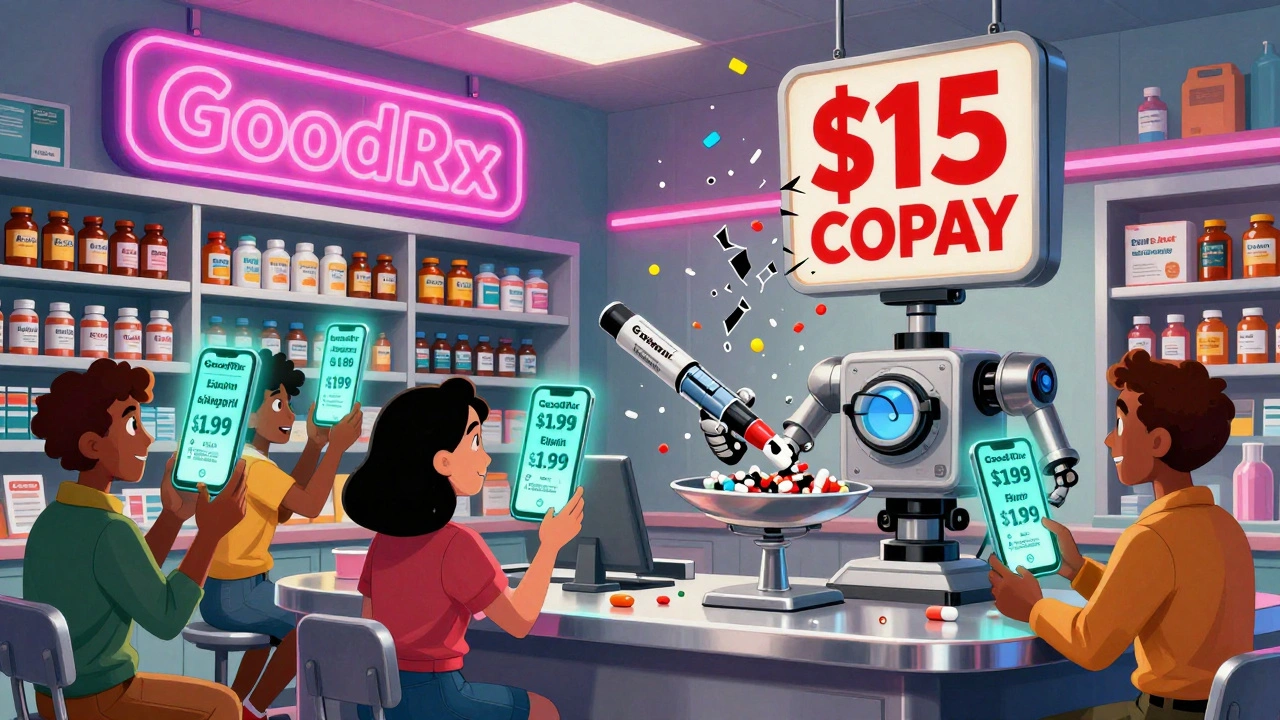
When you walk into a pharmacy to pick up your monthly prescription, you might assume the price is fixed - set by the drug company, the insurer, or the pharmacy. But what if the real price is hiding in plain sight? In the U.S., a quiet but powerful force called generic price wars is reshaping how much you pay for medications - if you know where to look.
Generic drugs are chemically identical to brand-name pills. They work the same way. They’re just cheaper. And when multiple companies start making the same generic drug, prices don’t just drop - they collapse. That’s a price war. And consumers win - but only if they know how to play the game.
How Generic Price Wars Actually Work
It all started in 1984 with the Hatch-Waxman Act. Before that, generic drug makers had to run expensive clinical trials to prove their versions were safe. The law changed that. Now, they just need to prove their pill is absorbed the same way as the brand. That cut costs dramatically and opened the door for competition.
Here’s what happens next: one company launches a generic. Price drops 15-30%. A second company enters. Price drops again. By the time four or five manufacturers are making the same drug, prices fall by 80-85%. With six or more, you’re looking at 95% off the original brand price.
Take metformin, the most common diabetes drug. When only one company made the generic, it cost $150 a month. Today, with over 10 manufacturers, you can get a 90-day supply for under $4 at Walmart. That’s not a sale. That’s the result of pure competition.
Why You’re Still Paying Too Much (Even When Generics Are Cheap)
Here’s the twist: just because a generic drug is cheap doesn’t mean you’re getting the deal. Most Americans pay for prescriptions through insurance. And that’s where things get messy.
Pharmacy Benefit Managers (PBMs) - the middlemen between insurers, pharmacies, and drug makers - control what you pay. They negotiate rebates, set copays, and decide which drugs are covered. But they don’t always pass savings to you. In fact, they often keep the difference.
Here’s how it works: a generic drug costs the pharmacy $2. The PBM says your copay is $15. You pay $15. The pharmacy gets $2. The PBM pockets $13. That’s called “spread pricing.” It’s legal. And it’s why you might pay more for a $2 generic than for the brand-name version.
Some people pay $300 for an EpiPen even though a generic version exists for under $20. Why? Because their insurance plan doesn’t cover the generic, or their PBM’s formulary pushes them toward the brand. Or worse - their pharmacist can’t even tell them the cash price is cheaper. Until 2018, “gag clauses” legally stopped pharmacists from telling you that. Now it’s banned, but many still don’t know to ask.
The Real Savings: Cash vs. Insurance
Here’s the most important thing you need to know: the cash price for a generic drug is often lower than your insurance copay.
According to the USC Schaeffer Center, in 28% of cases, paying cash for a generic is cheaper than using insurance. That’s not a typo. It’s 1 in every 3 prescriptions.
Take lisinopril, a blood pressure pill. Your insurance copay might be $10. But the cash price at CVS? $4. At Walmart? $0. At GoodRx, you can find it for $1.99. You don’t need insurance. You just need to ask.
Same with atorvastatin (Lipitor generic). Insurance copay: $15. Cash price: $3.50. That’s not a discount. That’s a 75% saving - and you don’t need to file a claim.
And it’s not just small towns. This happens in Austin, Chicago, New York - everywhere. The problem isn’t availability. It’s awareness.
Who Controls the Market? (And Why It Matters)
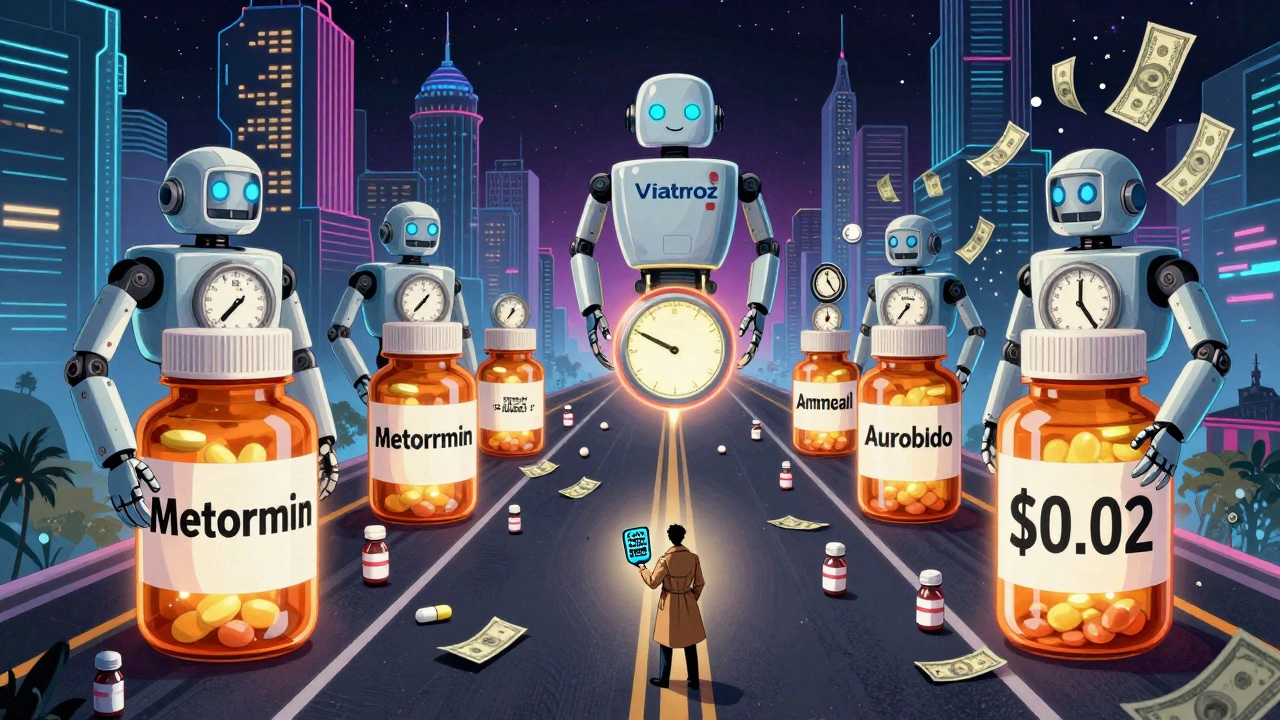
There are over 500 generic drug makers in the U.S. But just five companies - Teva, Viatris, Sandoz, Amneal, and Aurobindo - control over 60% of the market. That’s not competition. That’s an oligopoly.
When only a few players control most of the supply, they can coordinate prices - not always openly, but enough to keep them from dropping further. That’s why some generics still cost $50 even when there are four manufacturers. It’s not scarcity. It’s collusion.
And when prices fall too low, manufacturers quit. That’s what happened with doxycycline, a common antibiotic. When the price dropped to $0.02 per pill, no one could make a profit. Production stopped. Shortages followed. Now, the same drug costs $100. That’s not competition. That’s market failure.
How to Actually Save Money (Step-by-Step)
You don’t need a degree in pharmacy to save hundreds a year. Here’s how to get the real price:
- Ask for the cash price - every time. Say: “What’s the lowest price I can pay without insurance?” Don’t assume your copay is the best deal.
- Use GoodRx or SingleCare - these apps show real-time prices at nearby pharmacies. Compare CVS, Walgreens, Walmart, and Costco. Prices can vary by 300%.
- Check for $4 lists - Walmart, Costco, and some regional chains offer a list of 100+ generics for $4 (30-day supply) or $10 (90-day). Metformin, levothyroxine, sertraline - all on the list.
- Don’t trust the brand name - If your doctor writes “Lipitor,” ask if “atorvastatin” is okay. Same drug. 90% cheaper.
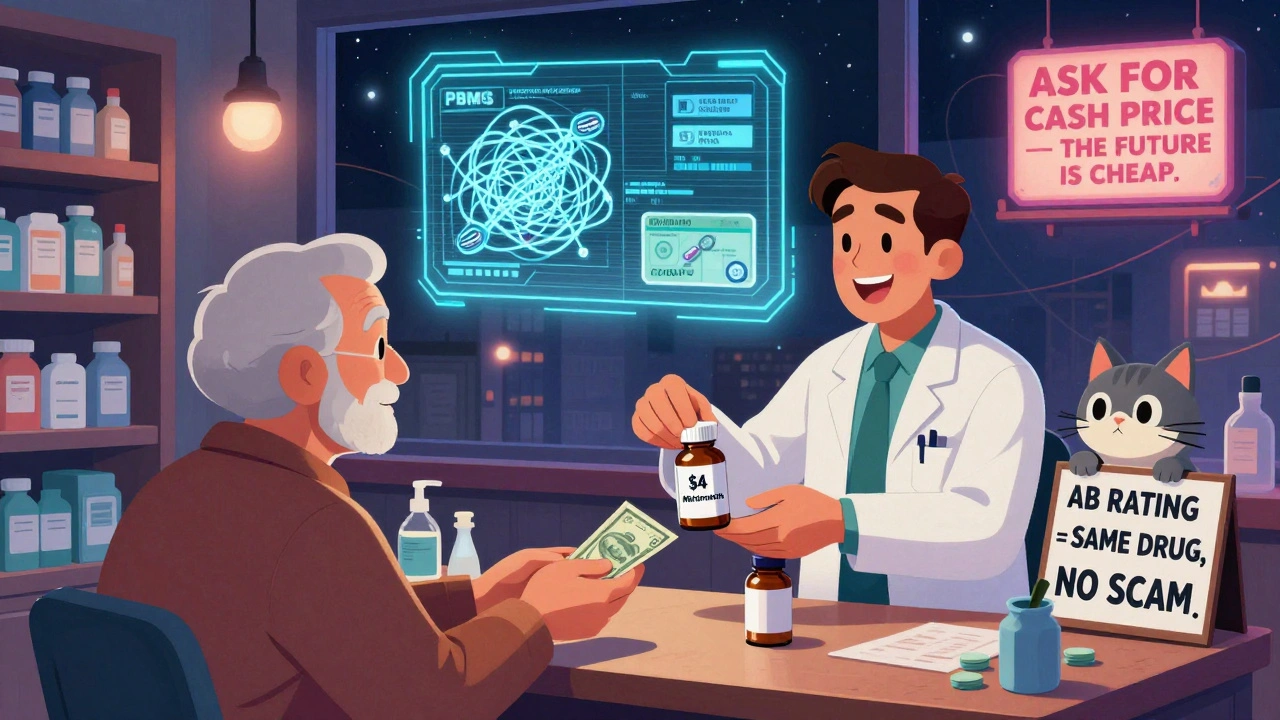
- Look for AB ratings - On the FDA’s website or your pharmacy’s label, check for “AB” next to the generic. That means it’s bioequivalent. No need to pay more for a “premium” version.
Spending 10 minutes checking prices before filling a prescription can save you $200-$500 a year. For chronic conditions like diabetes, high blood pressure, or depression, that’s hundreds every month. Multiply that over five years? That’s a vacation. A new car. Emergency savings.
What’s Changing? (And What’s Not)
The government is starting to act. The 2022 Inflation Reduction Act lets Medicare negotiate prices for some drugs. The 2023 Pharmacy Benefit Manager Transparency Act would force PBMs to pass savings to patients. The FTC is pushing to ban spread pricing entirely.
But until those laws take full effect, the system stays broken. The FDA approved 1,010 generic drugs in 2023 - up from 748 in 2022. More competition is coming. But if the middlemen keep taking the savings, you won’t see it.
And here’s the truth: the U.S. spends 23% of its total drug budget on generics - but those generics make up 90% of all prescriptions. That means we’re paying way too much for cheap medicine. The problem isn’t the drugs. It’s the system.
Final Thought: You’re Not Powerless
Generic price wars are real. The savings are real. But they don’t come automatically. They come when you ask. When you compare. When you refuse to accept the first price you’re given.
Next time you get a prescription, don’t just hand over your card. Ask for the cash price. Open GoodRx. Walk into Walmart. You might be shocked - and you’ll definitely be saving.
It’s not about being a savvy shopper. It’s about knowing your rights. And in a system designed to hide savings, that’s the only thing that works.
patrick sui
December 3, 2025 AT 03:47Wow, this is the most lucid breakdown of generic drug pricing I’ve ever read. The PBM spread pricing detail? Mind blown. 🤯 I’ve been paying $12 for lisinopril via insurance for years - just checked GoodRx, $1.99 at CVS. I’m literally going to cancel my copay plan for meds now. This changes everything.
Conor Forde
December 4, 2025 AT 08:04So let me get this straight - we’re paying more for a $2 pill because some corporate middleman in New Jersey decided he wanted a latte? 🤡 The system isn’t broken. It’s been *designed* to bleed us dry. And the FDA approves 1000 generics a year while we’re still getting gouged? I’m starting a petition: ‘Ban PBMs Before I Start Selling My Kidney on eBay.’
Declan O Reilly
December 5, 2025 AT 09:13There’s something deeply poetic about how capitalism works here - innovation in manufacturing meets exploitation in distribution. We’ve solved the science of making medicine cheap, but we haven’t solved the ethics of who gets to keep the savings. It’s not about the pill. It’s about the power. And power doesn’t like to be questioned - especially when it’s hiding behind a pharmacy counter and a ‘copay’ sticker.
I used to think ‘generic’ meant ‘inferior.’ Now I know it means ‘unfairly priced.’
Next time someone says ‘you get what you pay for,’ hand them a $4 metformin bottle and ask if they still believe it.
Nnaemeka Kingsley
December 6, 2025 AT 10:29Bro this is real. I been paying $20 for my blood pressure pills in Nigeria, but here in US? My cousin told me to check Walmart - $3 for 90 days. I thought he lying. Turned out he right. Just ask cash price. No insurance needed. Life changing.
Kshitij Shah
December 7, 2025 AT 13:45So the U.S. spends 23% of its drug budget on generics that make up 90% of prescriptions… and we’re still the most expensive country on Earth for medicine? 😂 I mean, congrats, America. You’ve perfected the art of paying for air.
Also, ‘AB rating’? That’s the FDA’s version of ‘this thing works, stop overpaying.’ And yet we still pay $300 for an EpiPen. I’m not mad. I’m just… disappointed.
Courtney Co
December 7, 2025 AT 23:15Wait, so you’re saying I could’ve been saving $400 a year and I didn’t know? I feel so stupid. I’ve been crying to my therapist about my bills and now I find out I’m just bad at pharmacy shopping? 😭 I’m gonna start yelling at every pharmacist I see. I need to feel something. Also, can we talk about how this is a feminist issue? Women take more meds. We’re the ones getting screwed. I’m so angry. I need a hug.
Shashank Vira
December 8, 2025 AT 08:52How quaint. You treat this like a consumer choice problem. But the real tragedy is not the $4 metformin - it’s that we’ve reduced human health to a spreadsheet. The pharmaceutical-industrial complex is not a market. It’s a cathedral of extraction. You think asking for a cash price is rebellion? It’s a Band-Aid on a hemorrhage. The system is designed to make you feel empowered while it hollows you out. You’re not saving money - you’re just surviving longer in a machine that was never meant to care.
Declan Flynn Fitness
December 8, 2025 AT 15:49Big shoutout to the original post - this is the kind of info that should be taught in high school. 🙌 I’ve been telling my gym buddies for years to check GoodRx before they swipe their card. One guy saved $200 on his antidepressants last month. We’re not just lifting weights here - we’re fighting a broken system. One prescription at a time. 💪