
How to Address Stigma When Discussing Mental Health Medications
Why Talking About Mental Health Medications Feels So Hard
Imagine you’re at work, and someone asks how you’re doing. You say you’re managing your anxiety. They nod, then ask, “Are you on meds?” Suddenly, your throat tightens. You mumble something vague and change the subject. You’re not alone. Millions of people feel this way-not because they’re ashamed of their condition, but because of the weight behind the word medication.
Stigma around mental health meds isn’t just about judgment. It’s about being seen as weak, broken, or even dangerous. People assume you’re taking pills to escape reality, not to balance brain chemistry. Some think it’s like recreational drugs. Others believe if you just tried harder, prayed more, or meditated longer, you wouldn’t need them. These myths aren’t just annoying-they’re dangerous. They keep people from getting help.
Here’s the truth: 70-80% of people with moderate to severe depression need medication, not just therapy, to get better. That’s not a last resort. That’s standard care. Yet, 25% of patients stop taking antidepressants within 30 days because they’re embarrassed. And 45% say they feel ashamed just carrying the pills in their purse or pocket.
How Language Changes Everything
Words matter more than you think. Saying “I take meds” sounds casual. But “I take medication for my depression” sounds medical. And that’s the point. Research from the National Institute of Mental Health shows that using terms like “meds,” “pills,” or “drugs” increases negative attitudes by 41%. Replace them with “medication” or “treatment,” and the tone shifts.
Think about how we talk about other illnesses. Nobody says, “I’m on insulin for my diabetes” like it’s a secret. We say, “I take insulin every morning.” It’s routine. It’s normal. Why should taking medication for anxiety or bipolar disorder be any different?
When you say “I take medication for my brain,” you’re not apologizing. You’re stating a fact. Just like someone with high blood pressure takes a pill daily, you take one to keep your mood stable. That’s not weakness. That’s self-care.
Normalizing Treatment Through Comparison
One of the most powerful tools in reducing stigma is comparison. Not to diminish other illnesses, but to show that mental health conditions are medical, not moral.
Try this: “I take medication for my brain the way someone else takes insulin for their pancreas. It’s not about willpower. It’s about biology.”
That simple sentence cuts through myths. People understand diabetes. They get heart disease. They know those aren’t choices. Mental health conditions are the same. The brain is an organ. It can get sick. Medication helps it work right.
Studies show that when people hear this kind of comparison, stigma drops by 34%. It’s not magic. It’s clarity. When you link mental health treatment to physical health treatment, you’re not just educating-you’re humanizing.
What Providers Should Say (and Not Say)
Healthcare providers hold a lot of power. A 2021 study found that 22% of primary care doctors hold negative views about patients asking for psychiatric meds. That’s not just bias-it’s a barrier to care.
Instead of saying, “Have you tried therapy first?” try: “Many people benefit from combining therapy and medication. Would you like to talk about how medication might help you?”
Or better yet: “I’ve seen how well this works for people with your symptoms. Let’s look at your options.”
The Mayo Clinic recommends a three-step approach:
- Normalize: “Many people take medication for mental health-just like people take pills for high blood pressure.”
- Educate: “This helps balance chemicals in your brain, similar to how insulin balances sugar.”
- Personalize: “For me, this helped me get through workdays without crying.”
That last part is key. Sharing your own experience-even if it’s small-makes it real. When a doctor says, “I’ve had patients who felt the same way, and this made a difference,” it changes everything.
When You’re the One Taking the Medication
What if you’re the one holding the bottle? How do you talk about it without feeling like you’re confessing a crime?
Start small. With someone you trust. Say: “I’ve been working on my mental health, and medication’s part of that. It’s not perfect, but it helps.” You don’t owe anyone a detailed explanation. You don’t need to justify it.
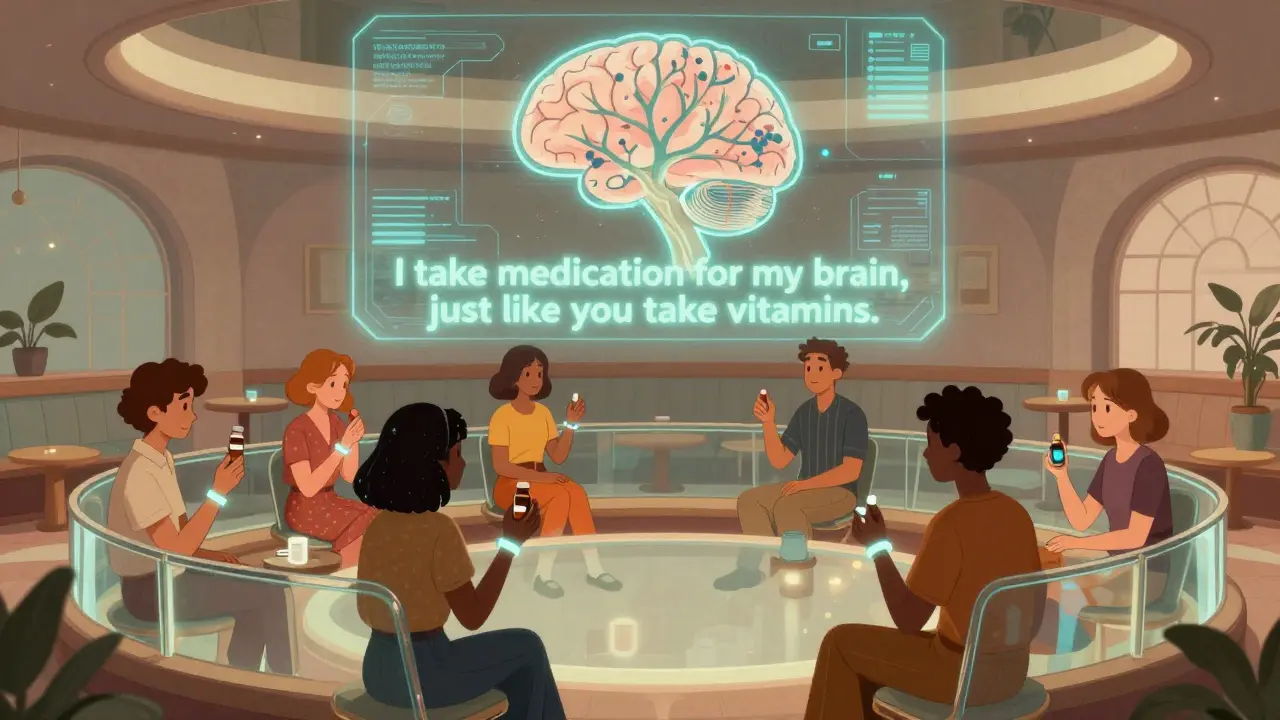
On Reddit, one user shared: “I started saying, ‘I take medication for my brain health, just like you take vitamins.’” That post got over a thousand upvotes. People responded with, “I do too,” or “I never thought of it that way.”
It’s not about convincing everyone. It’s about finding your people. The ones who nod and say, “That makes sense.” The ones who don’t flinch when you mention your prescription.
And if someone says something judgmental? You can say: “I know it’s not what you’re used to hearing, but this helps me live.” Then change the subject. You don’t have to fix their beliefs. You just have to protect your peace.
Why Peer Stories Work Better Than Statistics
Numbers are useful. But stories? They stick.
A 2023 study tracked 700 college students exposed to personal stories from peers who take psychiatric medication. After just one conversation, 22% more said they’d consider taking medication if needed. Why? Because seeing someone like you-smart, successful, kind-take medication removes the “otherness.”
YouTube creator John Green, with over 2 million subscribers, has talked openly about his SSRIs since 2017. His audience surveys show 68% of viewers felt less ashamed about their own medication after watching. That’s not just visibility. That’s connection.
Peer support specialists-people who’ve been there-are now being hired by clinics across the U.S. They don’t just offer advice. They offer proof: “I took this. I’m okay. I’m still me.”
That’s more powerful than any pamphlet.
What Doesn’t Work-and Why
Not all efforts to reduce stigma actually help. Some backfire.
Simulation exercises-like trying to experience hallucinations to build empathy-have increased stigma by 15% in some cases. Why? Because they turn illness into a spectacle. They make it feel like something scary, not something treatable.
And don’t assume silence is safe. A 2022 survey found 43% of people faced workplace discrimination after disclosing medication use. Some were passed over for promotions. Others were treated differently in meetings.
So don’t feel pressured to speak up if you’re not ready. But know this: the more people who speak, the less power stigma has. You don’t have to be loud. You just have to be honest-with yourself, and eventually, with others.
The Bigger Picture: Medication as Chronic Care
The CDC found that over 75% of people don’t see mental health conditions requiring medication as chronic illnesses-like diabetes or heart disease. That’s the root of the problem.
Chronic illness means long-term management. It doesn’t mean failure. It means care.
That’s why campaigns like the CDC’s “Medications as Medicine” are gaining traction. They reframe psychiatric meds as part of ongoing health maintenance-not a sign of crisis.
By 2026, the American Medical Association predicts 65% of antidepressant prescriptions will come from primary care doctors, not psychiatrists. That’s huge. When your regular doctor prescribes your medication, it stops feeling like a “mental health thing.” It becomes part of your health routine-just like your blood pressure pill.
What You Can Do Today
You don’t need a big platform to make a difference. Here’s what works:
- Use the word “medication,” not “meds” or “pills.”
- Compare mental health treatment to physical health treatment.
- If you’re a provider, ask: “What concerns do you have about taking medication?”
- If you’re a patient, say one honest thing to one person this week.
- Share a story-yours or someone else’s-without shame.
Stigma doesn’t vanish overnight. But it fades when we stop treating mental health meds like secrets and start treating them like care.
Why do people feel ashamed about taking mental health medication?
People feel ashamed because of deep-rooted myths-that taking medication means you’re weak, that it changes your personality, or that it’s like recreational drug use. These beliefs are reinforced by media, cultural stigma, and even well-meaning but misinformed comments from others. The truth is, medication helps balance brain chemistry, just like insulin helps with diabetes. Shame comes from misunderstanding, not from the medication itself.
Is it okay to take mental health medication long-term?
Yes. Many mental health conditions require ongoing management, just like high blood pressure or thyroid disorders. Stopping medication abruptly can lead to relapse. The goal isn’t to stay on it forever, but to use it as a tool to regain stability. Some people take it for months. Others for years. That’s not failure-it’s effective care.
How do I talk to my doctor about medication without feeling judged?
Start by saying, “I’ve been struggling with [symptoms], and I’d like to talk about whether medication could help.” If your doctor seems dismissive, it’s okay to ask for a referral or seek a second opinion. You deserve care without shame. Providers who use the Two-Question Approach-“How do you feel about taking medication?” and “What concerns do you have?”-are more likely to create a safe space for this conversation.
What should I do if someone says, “You don’t need meds, you just need to pray/meditate/exercise more”?
You can respond with, “I appreciate your concern. For me, medication is part of my treatment plan, just like how someone with asthma uses an inhaler. It’s not either/or-it’s both.” You don’t have to convince them. You just need to stand by your choice. If they keep pushing, it’s okay to change the subject or end the conversation.
Are there any side effects I should worry about?
All medications have possible side effects, but most are mild and temporary-like nausea, drowsiness, or headaches in the first few weeks. Serious side effects are rare. Your doctor will monitor you. The bigger risk is not taking the medication at all. Studies show that 40-60% of people see significant improvement with treatment. Waiting too long to start can make symptoms worse and harder to treat.
How can I help reduce stigma for others?
Use respectful language. Don’t say “crazy” or “on drugs.” Instead, say “someone taking medication for depression.” Share stories of people who benefit from treatment. Support campaigns that frame mental health care as normal medical care. And if you’re comfortable, speak up about your own experience. Stigma shrinks when we replace silence with honesty.