
Infographics About Generics: Visual Tools to Understand Generic Medications
More than 90% of prescriptions filled in the U.S. are for generic drugs. Yet, many people still hesitate to take them. Why? Because they don’t understand what generics really are. They see a pill that looks different from the brand-name version and assume it’s weaker, less safe, or made with inferior ingredients. That’s not true. But without clear, simple visuals, it’s hard to unlearn those myths. That’s where infographics about generics come in.
What Makes a Generic Drug the Same as a Brand Name?
The FDA requires generic drugs to meet the same strict standards as brand-name drugs. Same active ingredient. Same strength. Same way it works in your body. The only differences? Color, shape, flavor, and inactive ingredients like fillers or dyes. These don’t affect how the medicine works.
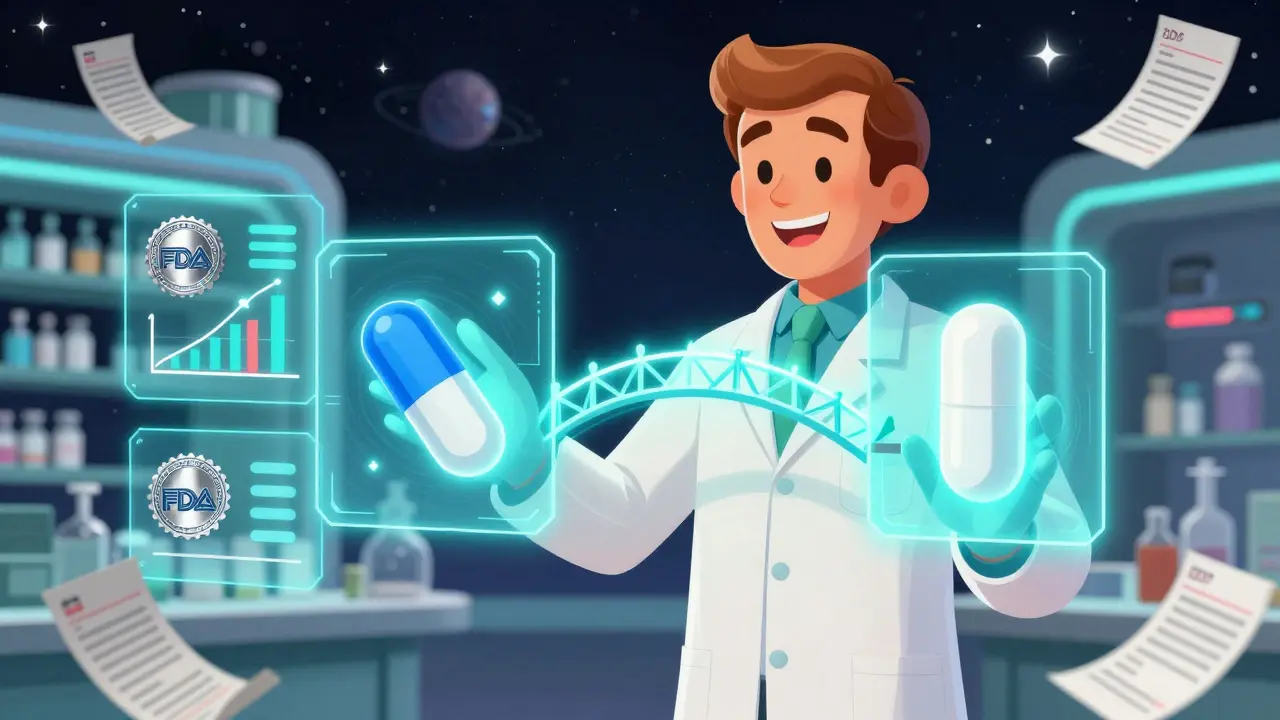
One of the most effective infographics from the FDA, titled What Makes a Generic the Same as a Brand-Name Drug?, uses side-by-side diagrams to show how both versions dissolve at the same rate in the body. This is called bioequivalence. The graphic breaks down the science without jargon. In testing, 89% of patients understood the concept just by looking at it. That’s the power of visual learning.
People often think if a generic looks different, it must be different. But a pill’s appearance is chosen for marketing, not medical reasons. A brand-name drug might be blue because the company thinks patients associate blue with calm. The generic? It might be white because it’s cheaper to produce. Neither affects how well it treats your condition.
How the FDA Ensures Generic Drugs Are Safe
There’s a big misconception that generics skip testing. They don’t. Every generic drug must prove it works the same way as the brand-name version. The FDA requires bioequivalence studies - real clinical tests - before approving any generic.
Infographics from the FDA show this process step by step: from lab testing to manufacturing inspections to post-market monitoring. Each step is illustrated with icons and short labels. One graphic compares the approval timeline for brand-name versus generic drugs. It shows that while brand-name drugs take years to develop, generics only need to prove they’re equivalent - not reinvent the wheel.
Manufacturers of generics must follow the same quality rules as big pharma companies. The FDA inspects their factories - same as brand-name sites - and can shut them down if standards slip. In 2022, the FDA inspected over 3,000 generic drug facilities worldwide. Not one was approved without meeting U.S. standards.
Why Generic Drugs Save Money - And How That Helps Patients
Generic drugs cost 80% to 85% less than brand-name versions. That’s not a guess. It’s backed by data. From 2010 to 2019, generics saved the U.S. healthcare system $1.68 trillion. In 2023 alone, they saved patients and insurers over $313 billion.
One infographic shows a simple bar chart: one bar for the cost of a brand-name blood pressure pill ($120/month), another for the generic ($12/month). The difference is obvious. For people on fixed incomes, that’s not just savings - it’s access. A patient might skip their medication if it’s too expensive. With a generic, they can stick to their treatment plan.
But cost isn’t the only benefit. Lower drug prices mean fewer people skip doses or split pills. Fewer hospital visits. Fewer emergencies. The ripple effect helps the whole system. The FDA’s infographics don’t just explain cost - they show how affordability leads to better health outcomes.
Who Uses These Infographics - And How
These visual tools aren’t just for patients. Pharmacists use them during consultations. Doctors hand them out in waiting rooms. Nurses post them on clinic walls. At Kaiser Permanente, 78% of pharmacists say they use FDA generic drug infographics regularly. One pharmacist in California said, “I print this and keep it behind the counter. It cuts counseling time in half.”
They’re also built into digital health systems. Epic, one of the largest electronic health record platforms, added FDA infographics to its patient portal in late 2022. Since then, over 450,000 patients have viewed them directly through their online accounts. Patients don’t have to ask for them - they’re right there when they log in to check their prescriptions.
Health systems that use these infographics see results. Clinics that distributed them for six months saw a 22% increase in patients accepting generic prescriptions. That’s not just better for wallets - it’s better for health.
Where These Infographics Fall Short
Not all generic drug infographics are perfect. Some still use technical language like “bioequivalence” or “dissolution rate” without explaining it in plain terms. A study on patient forums found that 29% of users still found the FDA’s visuals too complex, even though they’re written at an 8th-grade reading level.
Another gap? They don’t clearly show when a generic might need extra caution. For drugs like warfarin or levothyroxine - where tiny changes in dosage can matter - current infographics don’t highlight that pharmacists must notify patients before switching. The Institute for Safe Medication Practices says this is a real risk. A patient might assume all generics are exactly the same, even when they’re not.
There’s also a lack of focus on equity. African American and Hispanic patients report higher concerns about generic quality than white patients. Only one FDA infographic - the Generic Drugs and Health Equity Handout - directly addresses this. It shows how lower-cost generics help close gaps in care for underserved communities. More materials should follow this lead.
What’s Next for Generic Drug Education
These tools are evolving. In early 2023, the GTMRx Institute launched interactive digital infographics. You can plug in your medications, and the tool shows you which ones have generics, how much you’d save, and whether any require special attention.
The FDA is testing augmented reality features. Imagine scanning your pill bottle with your phone - and seeing a 3D model of the active ingredient, comparing your brand-name and generic versions side by side. It’s not science fiction. A prototype was shown at the 2023 Digital Health Innovation Summit.
By 2028, experts predict generic drug use could hit 95% - if education keeps up. That means more people will understand that a small, white pill isn’t “less than.” It’s the same medicine. Just cheaper. And just as effective.
How to Use These Tools in Real Life
You don’t need special training to use these infographics. Here’s how:
- Download the FDA’s free generic drug infographics from their website. They’re all in PDF format and print perfectly on standard paper.
- Keep one in your wallet or medicine cabinet. When you get a new prescription, pull it out and compare your pill to the image.
- Ask your pharmacist: “Do you have the FDA infographic about generic drugs?” Most do.
- Share it with family members who are hesitant about generics. A picture beats a 10-minute lecture.
- If you’re a caregiver or health worker, print copies for your waiting room. It’s a quiet way to reduce fear and confusion.
These tools aren’t just about facts. They’re about trust. When patients see clear, honest visuals, they stop worrying about being tricked. They start believing they’re getting the care they need - no matter the price tag.
Are generic drugs really as good as brand-name drugs?
Yes. The FDA requires generic drugs to have the same active ingredient, strength, dosage form, and route of administration as the brand-name version. They must also prove they work the same way in the body through bioequivalence testing. The only differences are in color, shape, flavor, and inactive ingredients - none of which affect how the medicine works.
Why do generic drugs look different from brand-name drugs?
By law, generic drugs can’t look exactly like the brand-name version. That’s to avoid trademark infringement. The differences in color, shape, or size are purely cosmetic. They don’t change how the drug works. The active ingredient - the part that treats your condition - is identical.
Can I trust generics made outside the U.S.?
Yes. The FDA inspects all manufacturing facilities - whether in the U.S., India, China, or elsewhere - before approving any generic drug. Over 3,000 facilities worldwide are inspected each year. If a plant doesn’t meet U.S. standards, the FDA blocks its products. You’re not taking a risk by choosing a generic made overseas.
Do generics take longer to work than brand-name drugs?
No. Generic drugs must dissolve in the body at the same rate as the brand-name version. This is called bioequivalence. The FDA tests this using scientific methods that measure how quickly the drug enters the bloodstream. If a generic dissolves too slowly or too fast, it won’t be approved.
Are there any drugs where generics aren’t recommended?
For most drugs, generics are safe and effective. But for a small group called narrow therapeutic index (NTI) drugs - like warfarin, levothyroxine, or phenytoin - even tiny differences in absorption can matter. Pharmacists must notify you before switching. While current infographics mention this in text, they don’t yet use visual cues to highlight these exceptions. Always ask your pharmacist if your drug falls into this category.
How do I know if my pharmacy switched my prescription to a generic?
Your prescription label will list the generic name of the drug, not the brand name. You can also ask your pharmacist directly. Most pharmacies will notify you if they’re substituting a generic. If you’re unsure, compare the pill to the images in FDA infographics - they show what common generics look like.
Where can I find free generic drug infographics?
The FDA offers all its generic drug infographics for free on its website at fda.gov/generics. They’re available in English and Spanish, downloadable as PDFs, and optimized for printing or digital viewing. The GTMRx Institute and BeMedWise also offer free resources, though the FDA’s are the most comprehensive and widely used.
Patrick Merrell
January 27, 2026 AT 21:39Let’s be real - if you’re still skeptical about generics, you’re either being scammed by pharma ads or you’ve never checked the FDA’s database. The science isn’t complicated. Same active ingredient. Same bioavailability. Same results. The only thing different is the price tag - and your wallet will thank you.
rasna saha
January 29, 2026 AT 09:56I used to refuse generics until my mom got prescribed levothyroxine and we switched. She was terrified - said the brand felt ‘stronger.’ We printed the FDA infographic, showed her the dissolution charts, and she cried. Not from sadness - from relief. She’s been on generic for 3 years now. No issues. Just cheaper, same medicine. ❤️
James Nicoll
January 29, 2026 AT 21:26So let me get this straight - we’ve got a system where a pill that costs $120 is ‘better’ than one that costs $12, purely because someone paid for a blue dye and a trademark? And we call this capitalism? I’d call it a scam dressed up as a brand. The FDA’s infographics are basically the only honest thing left in pharmaceutical marketing. Long live the white pill.
Uche Okoro
January 30, 2026 AT 06:44It’s worth noting that while bioequivalence thresholds are set at 80–125% AUC and Cmax, the variance within the generic supply chain can still introduce pharmacokinetic heterogeneity - particularly with NTI drugs. The current infographic framework fails to communicate this nuance adequately. Without visual indicators for therapeutic window sensitivity, patient adherence may be compromised due to implicit trust assumptions. This isn’t just education - it’s risk mitigation.
Ashley Porter
January 31, 2026 AT 18:47My pharmacist handed me the FDA infographic after I asked why my blood pressure med looked different. I thought it was a joke. Turns out, it was the most useful piece of paper I’ve ever received. No jargon. No pressure. Just facts. Now I print them for my parents. They still call them ‘the pill pictures.’
Peter Sharplin
February 1, 2026 AT 09:49I’ve worked in rural clinics for 18 years. The biggest barrier to generic adoption isn’t ignorance - it’s fear. Fear of being cheated. Fear of getting ‘second-rate’ care. These infographics don’t just explain science - they rebuild trust. I’ve seen patients who refused meds for years start taking them after seeing the side-by-side dissolution diagrams. One man said, ‘I didn’t know the medicine was the same. I thought the white one was for dogs.’ We laughed. Then he filled his prescription. That’s the power of visuals.
shivam utkresth
February 1, 2026 AT 15:43Back home in India, generics are the only option - and we’ve got some of the best manufacturers in the world. But here in the U.S., people act like generics are some kind of scam. Meanwhile, I’ve got cousins on the same meds - one in Delhi, one in Chicago - same pill, same batch code, same results. The real difference? The price. And the stigma. We need more of these infographics in schools, in mosques, in barbershops. Not just pharmacies.
John Wippler
February 1, 2026 AT 21:44There’s a quiet revolution happening here. It’s not in labs or boardrooms - it’s in waiting rooms, in wallets, in the quiet moment when someone looks at a white pill and realizes it’s not less - it’s just free. The FDA didn’t just make infographics. They made dignity available at 85% off. And that’s the most powerful thing any government agency has done in decades.