
Preventing Adverse Drug Reactions with Pharmacogenetic Testing
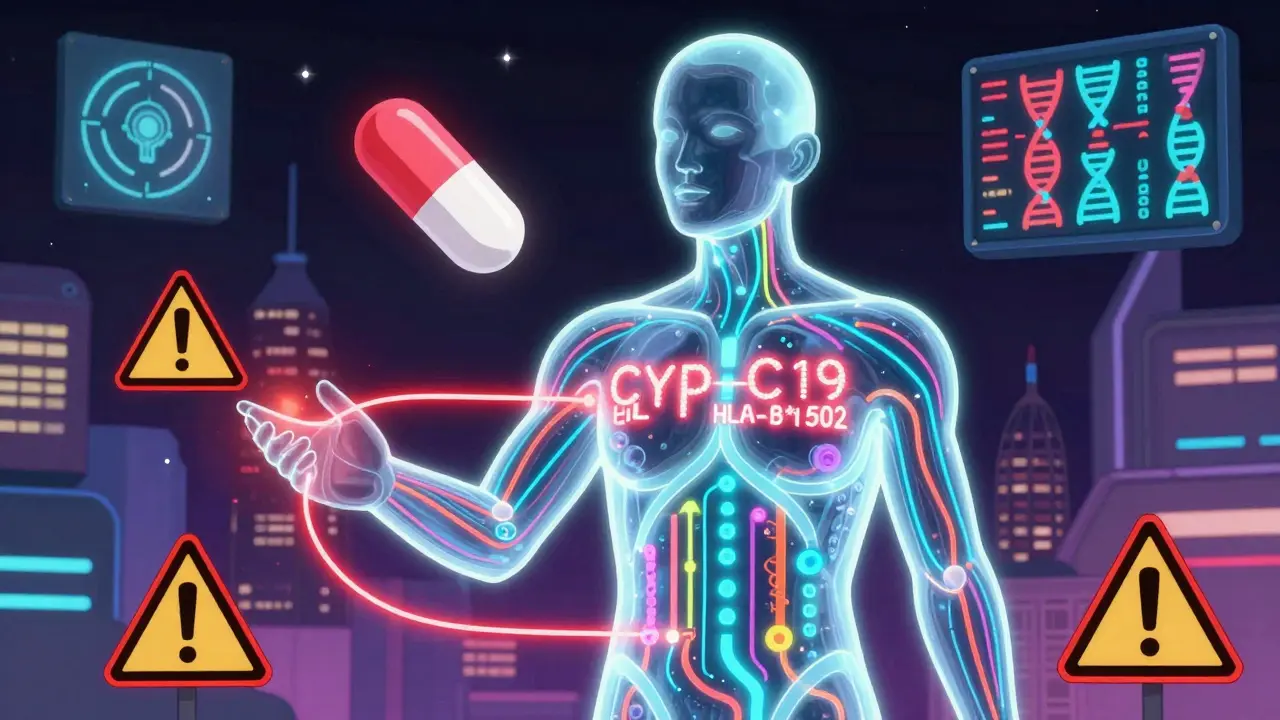
Every year, millions of people end up in the hospital not because their illness got worse, but because the medicine meant to help them made things worse. These are called adverse drug reactions - and they’re not rare. In the U.S. alone, ADRs cause over 1.3 million emergency room visits annually. Many of these reactions aren’t random. They’re tied to your genes.
Why Your Genes Matter When You Take Medicine
Not everyone processes drugs the same way. Two people can take the same pill at the same dose, and one might feel fine while the other gets sick. That’s not luck. It’s genetics. Your body uses enzymes - mostly from the CYP family - to break down medications. If you have a variant in the CYP2C19 gene, for example, you might metabolize clopidogrel (a blood thinner) too slowly. That means the drug doesn’t work, and you’re at risk for a heart attack. On the flip side, if you’re a rapid metabolizer, the drug gets cleared too fast, and you might need a higher dose to get the same effect. Some gene variants don’t just change how fast a drug is processed - they can trigger dangerous immune responses. Take carbamazepine, a drug used for epilepsy and nerve pain. In people of Southeast Asian descent who carry the HLA-B*1502 gene variant, taking this drug can lead to Stevens-Johnson syndrome - a life-threatening skin reaction. Testing for this variant before prescribing cuts the risk by 95%.What Pharmacogenetic Testing Actually Does
Pharmacogenetic testing looks at your DNA to find specific gene variants that affect how you respond to medications. It doesn’t predict if you’ll get cancer or diabetes. It tells your doctor: “This drug might not work for you,” or “This one could kill you.” The most common panel used in clinical practice tests 12 key genes: CYP2C19, CYP2D6, CYP2C9, CYP3A5, SLCO1B1, TPMT, DPYD, VKORC1, UGT1A1, CYP4F2, SLC01B1, and HLA-B. Together, these genes influence how your body handles more than 100 commonly prescribed drugs - from antidepressants and painkillers to blood thinners and chemotherapy agents. The test is simple: a cheek swab or blood sample. Results come back in 24 to 72 hours. Modern labs use genotyping arrays that detect variants with 99.9% accuracy. Once the results are in, they’re loaded into your electronic health record. If a doctor tries to prescribe a drug that could cause harm based on your genes, the system flashes a warning - like a seatbelt alarm for your meds.The Proof: How Much This Actually Works
The biggest real-world proof came from the PREPARE study, published in The Lancet in 2023. Researchers tracked nearly 7,000 patients across seven European countries. Half got standard care. The other half had their genes tested before any new drug was prescribed. The result? A 30% drop in serious adverse drug reactions in the group that got tested. That’s not a small number. That’s 3 out of every 10 people who avoided hospitalization, ICU stays, or worse. And it’s not just one drug. In psychiatric care, patients whose treatment was guided by genetic results had significantly fewer side effects after just three months. In cancer care, preemptive testing prevented over 100 adverse reactions per 1,000 patients treated with gene-informed drugs. Compare that to traditional methods. Therapeutic drug monitoring checks blood levels after you’ve already taken the drug - too late to prevent harm. Clinical risk scores guess your risk based on age, weight, or kidney function - but they miss the genetic piece entirely.Who Benefits the Most?
Some groups see the biggest payoff:- People on multiple medications - polypharmacy increases the chance of a bad interaction. One gene variant can affect five different drugs at once.
- Patients with psychiatric conditions - antidepressants and antipsychotics have high failure and side effect rates. Genetics can cut trial-and-error time from months to days.
- Cancer patients - chemo drugs like 5-FU (used for colon cancer) can be deadly if you have a DPYD variant. Testing prevents fatal toxicity.
- Older adults - metabolism slows with age, and they often take 5+ drugs. Genetics helps untangle what’s causing the dizziness, nausea, or confusion.

Costs and Coverage - Is It Worth It?
A full pharmacogenetic panel costs between $200 and $500 in the U.S. That sounds steep - until you look at what it prevents. An adverse drug reaction can cost $15,000 to $50,000 in hospital bills. The PREPARE study found that testing saved money in every scenario tested. The NHS estimates ADRs cost the UK £500 million a year - nearly all avoidable. Medicare and Medicaid already cover testing for specific high-risk cases: CYP2C19 before clopidogrel, TPMT before azathioprine, and DPYD before 5-FU. Private insurers are catching up. And the trend is clear: 87% of major U.S. academic hospitals plan to offer preemptive testing by 2026.The Hurdles - Why This Isn’t Everywhere Yet
Despite the evidence, adoption is slow. Why?- Clinicians aren’t trained - only 37% of doctors feel confident interpreting results. A pharmacist might know what a CYP2D6 poor metabolizer means. A general practitioner? Often not.
- Integration is messy - getting test results into EHRs and triggering alerts takes tech investment. Many clinics still print results and file them in paper charts.
- “Intermediate metabolizer” results confuse people - if you’re not a fast or slow metabolizer, but somewhere in between, what do you do? Guidelines help, but they’re not always clear.
- Genetic diversity gaps - most research has been done in European populations. Variants common in African, Indigenous, or Asian groups were often left out. New studies from the NIH are fixing this, adding 126 new gene-drug links from underrepresented groups.
What’s Next?
The future of pharmacogenetics isn’t just one gene at a time. Researchers are now building polygenic risk scores - combining dozens of small genetic signals to predict how you’ll respond to a drug. Early results show these scores are 40-60% more accurate than single-gene tests. Costs are dropping too. A pilot project by Thermo Fisher showed point-of-care PCR tests could bring the price down to $50-$100 by 2026. Imagine walking into your doctor’s office, getting a quick swab, and walking out with a personalized drug list - all in 15 minutes. The European Commission is investing €150 million to roll out preemptive testing nationwide by 2027. The FDA updated its list of gene-drug pairs from 287 to 329 in just two years. That’s not just progress - it’s acceleration.
Chris Buchanan
December 23, 2025 AT 17:57Wilton Holliday
December 24, 2025 AT 09:07Raja P
December 26, 2025 AT 05:26Joseph Manuel
December 27, 2025 AT 16:10Andy Grace
December 27, 2025 AT 19:24Delilah Rose
December 29, 2025 AT 17:49Lindsey Kidd
December 30, 2025 AT 08:57John Pearce CP
December 31, 2025 AT 03:13Ajay Sangani
January 1, 2026 AT 12:10Gray Dedoiko
January 2, 2026 AT 21:11Joe Jeter
January 3, 2026 AT 21:06Jeffrey Frye
January 5, 2026 AT 17:08Austin LeBlanc
January 6, 2026 AT 21:25