
Rifampin and Oral Contraceptives: What You Need to Know About Birth Control Failure
Contraceptive Failure Risk Calculator
Calculate Your Risk
When you're on birth control, you expect it to work. But what if a common antibiotic you're prescribed to treat tuberculosis or a stubborn staph infection could make your pill useless? That’s not a myth - it’s science. And the antibiotic responsible is rifampin.
Rifampin has been around since the 1960s. It’s powerful, effective, and cheap - which is why it’s still a go-to for treating tuberculosis and some serious bacterial infections. But it’s also the only antibiotic with solid, repeated proof that it can cause birth control pills to fail. Not just sometimes. Not just in rare cases. This interaction is well-documented, predictable, and dangerous enough that medical guidelines demand action.
How Rifampin Breaks Down Birth Control
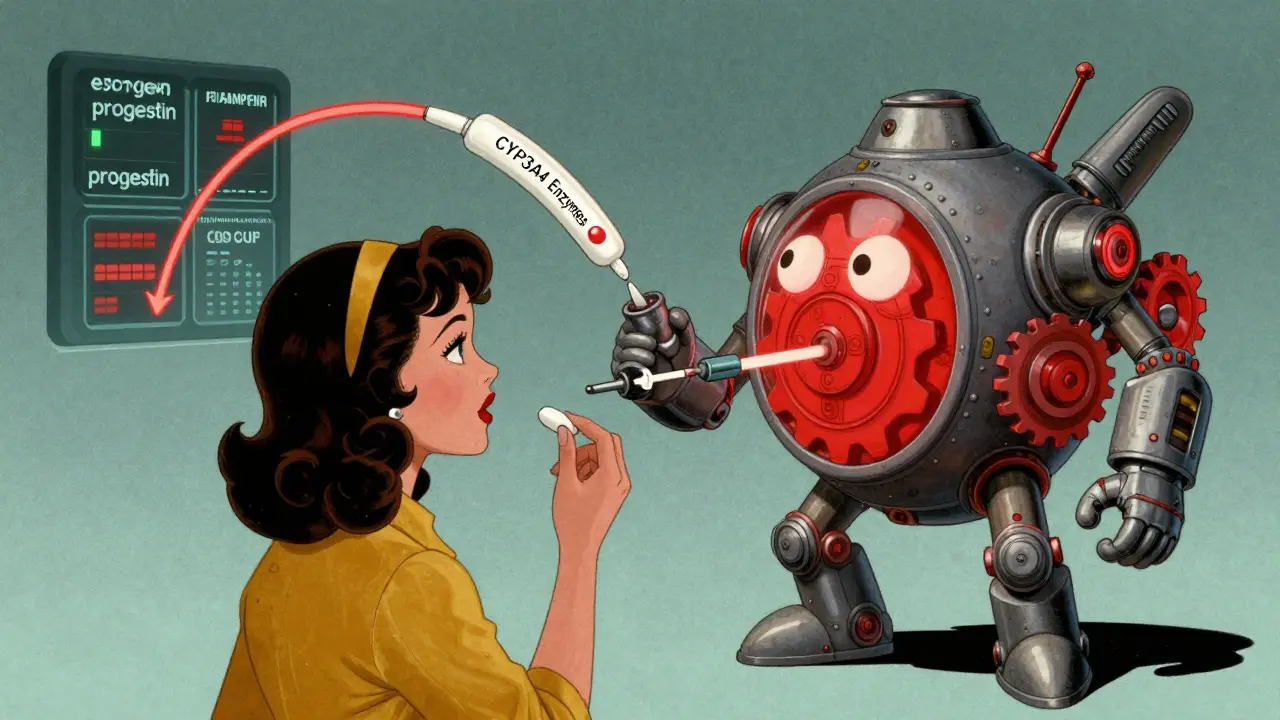
Your birth control pill works because it keeps steady levels of estrogen and progestin in your blood. These hormones stop ovulation, thicken cervical mucus, and thin the uterine lining - all to prevent pregnancy. But rifampin doesn’t just treat infection. It changes how your body handles hormones.
Rifampin triggers your liver to crank up production of enzymes - specifically CYP3A4 - that break down drugs. Within 24 to 48 hours of starting rifampin, your body starts metabolizing the hormones in your pill faster than normal. Studies show this can slash estrogen levels by up to 67% and progestin levels by over 50%. That’s not a small drop. That’s enough to bring hormone concentrations below the threshold needed to prevent ovulation.
Think of it like this: your pill is a steady drip of hormones. Rifampin turns the tap into a firehose - but instead of delivering more, it drains it out too fast. The result? Your body may start ovulating again, even if you’re taking your pill every day.
What Happens When It Fails
The consequences aren’t theoretical. Women have gotten pregnant while on birth control and taking rifampin. Some didn’t even realize they were at risk. Others noticed signs like breakthrough bleeding or spotting - early red flags that their hormones were being scrambled.
One 2018 review in BJOG analyzed all available evidence and found that rifampin was linked to ovulation in up to half of women studied. That’s not a coincidence. That’s a pattern. And while we don’t have exact numbers on how many pregnancies have happened because of this, we know it’s happened often enough that doctors now treat it like a guaranteed risk.
It’s not just about pregnancy. Some women experience irregular periods, heavy bleeding, or even missed periods - all signs that their hormonal system is being disrupted. These symptoms can be mistaken for stress, illness, or side effects of the TB treatment itself. But they’re often the first clue that the pill isn’t working anymore.
Not All Antibiotics Are the Same
Here’s where things get confusing - and why so many people get it wrong.
For years, doctors warned patients that all antibiotics could interfere with birth control. You’d hear: "Take extra precautions when on any antibiotic." But that advice was based on old case reports and fear, not science.
Penicillin? Amoxicillin? Azithromycin? Tetracycline? These have all been blamed in the past. But when researchers looked closely - in controlled studies, not just anecdotal reports - none of them showed a real drop in hormone levels. A 2019 report from the American Academy of Family Physicians reviewed over 100 cases of contraceptive failure linked to antibiotics between 1970 and 1999. Only one antibiotic showed up every single time: rifampin.
Even rifabutin, a cousin of rifampin used for certain infections, has a much weaker effect. It cuts hormone levels by about 20-30%, not 50-60%. So while it still needs caution, it’s not as dangerous.
And here’s the kicker: some antibiotics might actually make birth control work better. Ketoconazole, for example, blocks the same liver enzymes that rifampin activates. That can cause hormone levels to build up - raising the risk of side effects like blood clots. So the interaction isn’t always one-way.
How Long Does the Risk Last?
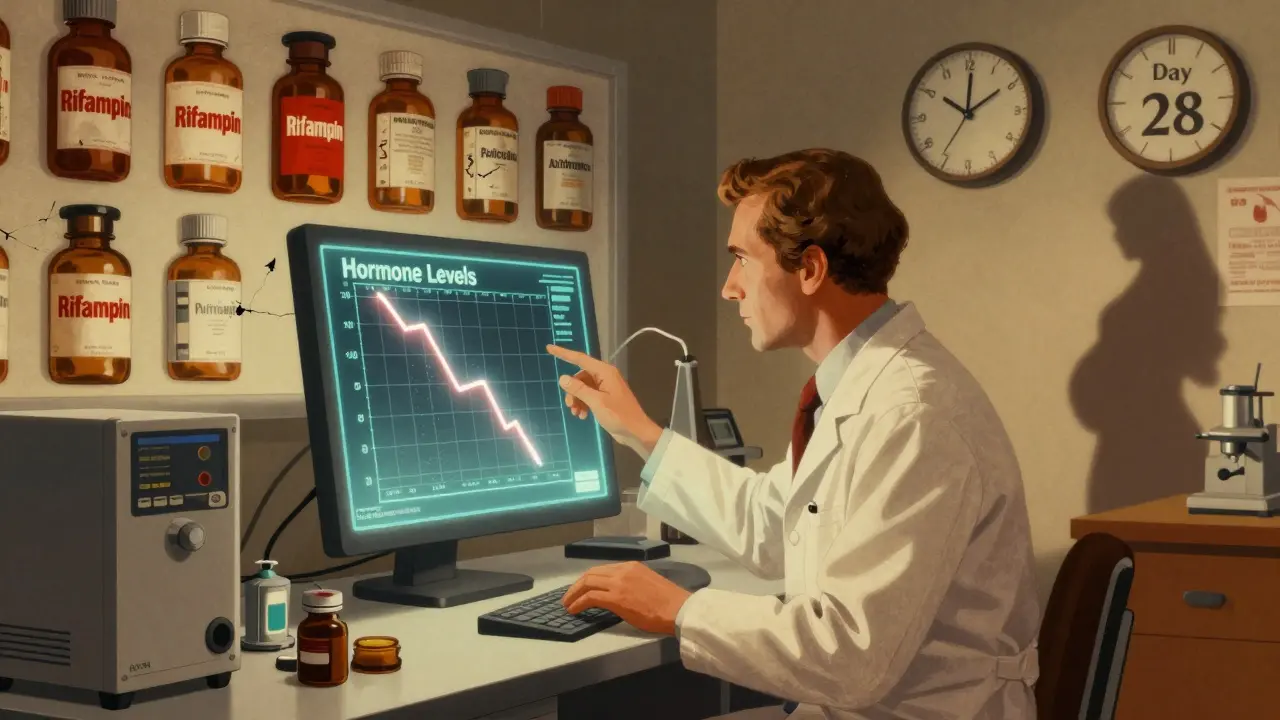
This is where most people mess up. Rifampin’s half-life is only 3 to 4 hours. So you might think: "I stop taking it on day 14, so I’m safe after that." But that’s not how enzyme induction works.
Once rifampin wakes up your liver enzymes, they don’t just shut off the next day. They keep churning out hormones at a faster rate for weeks. Studies show it takes 28 days after your last dose for enzyme levels to return to normal. That’s why guidelines say: use backup contraception for the entire time you’re on rifampin - and for four weeks after you finish.
Skipping that last month? That’s when most unintended pregnancies happen. Women think they’re safe because they’re off the antibiotic. But their body is still clearing out the effects of rifampin. And if they have unprotected sex during that window? Risk is real.
What Should You Do?
If you’re prescribed rifampin - whether for TB, a skin infection, or something else - here’s what you need to do right now:
- Don’t stop your birth control pill. Stopping it increases your risk of pregnancy even more.
- Use a non-hormonal backup method. Condoms work, but they’re not foolproof. The best option is a copper IUD. It’s 99% effective, lasts for years, and isn’t affected by any drug. If you don’t have one, use condoms every time - no exceptions.
- Keep using backup for 28 days after your last rifampin dose. Don’t assume you’re safe just because you feel better.
- Talk to your doctor about switching. If you’re on long-term rifampin therapy (like for TB), consider switching to a non-hormonal method permanently. Hormonal IUDs (like Mirena) or implants (like Nexplanon) might still be options - but only if you’re on low-dose rifampin or for a short time. Newer studies suggest implants may hold up better, but evidence isn’t strong enough yet to rely on them alone.

Why This Still Isn’t Fixed
Here’s the uncomfortable truth: we’ve known about this for over 50 years. The first case reports came out in the 1970s. Guidelines have been clear since the 1990s. Yet, a 2022 study found that 63% of women prescribed rifampin still didn’t get proper counseling.
Why? Because doctors forget. Or they assume patients know. Or they think the risk is too small to worry about. But when it comes to pregnancy, "small risk" means a life-changing event. And for women in high-TB areas - like parts of Africa or Southeast Asia - this interaction isn’t just a medical issue. It’s a reproductive justice issue.
Drug companies now test every new birth control formula against rifampin before approval. The FDA and EMA require it. But that doesn’t help women who are already on old pills. And it doesn’t fix the gap between knowing and doing.
What’s Changing Now?
There’s hope. New TB treatments are being tested that avoid rifampin entirely. One 4-month regimen using rifapentine and moxifloxacin showed promising results in a 2022 trial. If approved, it could replace the old 6-month rifampin-heavy regimens - reducing this risk for millions.
Meanwhile, researchers are studying whether higher-dose implants like Nexplanon can resist rifampin’s effects. Early data from a 2023 study with 47 women showed no pregnancies - but the group was too small to be certain. Still, it’s a step forward.
For now, the safest advice remains simple: if you’re on rifampin, treat your birth control like it’s broken. Use backup. Always. For the full 28 days after. And talk to your doctor - not just about your infection, but about your body, your choices, and your future.
Shruti Chaturvedi
March 13, 2026 AT 14:48Katherine Rodriguez
March 14, 2026 AT 18:01Devin Ersoy
March 15, 2026 AT 10:39Scott Smith
March 16, 2026 AT 16:54tynece roberts
March 17, 2026 AT 12:35Hugh Breen
March 17, 2026 AT 20:17One insertion. Zero maintenance. Zero drug interactions. Lasts 10+ years. Works during TB treatment. Works during chemo. Works during a zombie apocalypse.
And if you're worried about pain? It's 10 minutes. And you'll thank yourself for decades.
Stop gambling with your fertility. Get the copper. It's the ultimate 'fuck you' to pharmaceutical negligence.
Byron Boror
March 19, 2026 AT 10:31Lorna Brown
March 20, 2026 AT 16:01Kandace Bennett
March 21, 2026 AT 23:03Tim Schulz
March 22, 2026 AT 04:54Meanwhile, Big Pharma is busy marketing new "smart" pills with app integration and glow-in-the-dark packaging. The real innovation? Teaching doctors to read the damn manual.
Jinesh Jain
March 22, 2026 AT 11:20