
Should You Stay on Brand NTI Drugs When Generic Substitution Is Allowed?
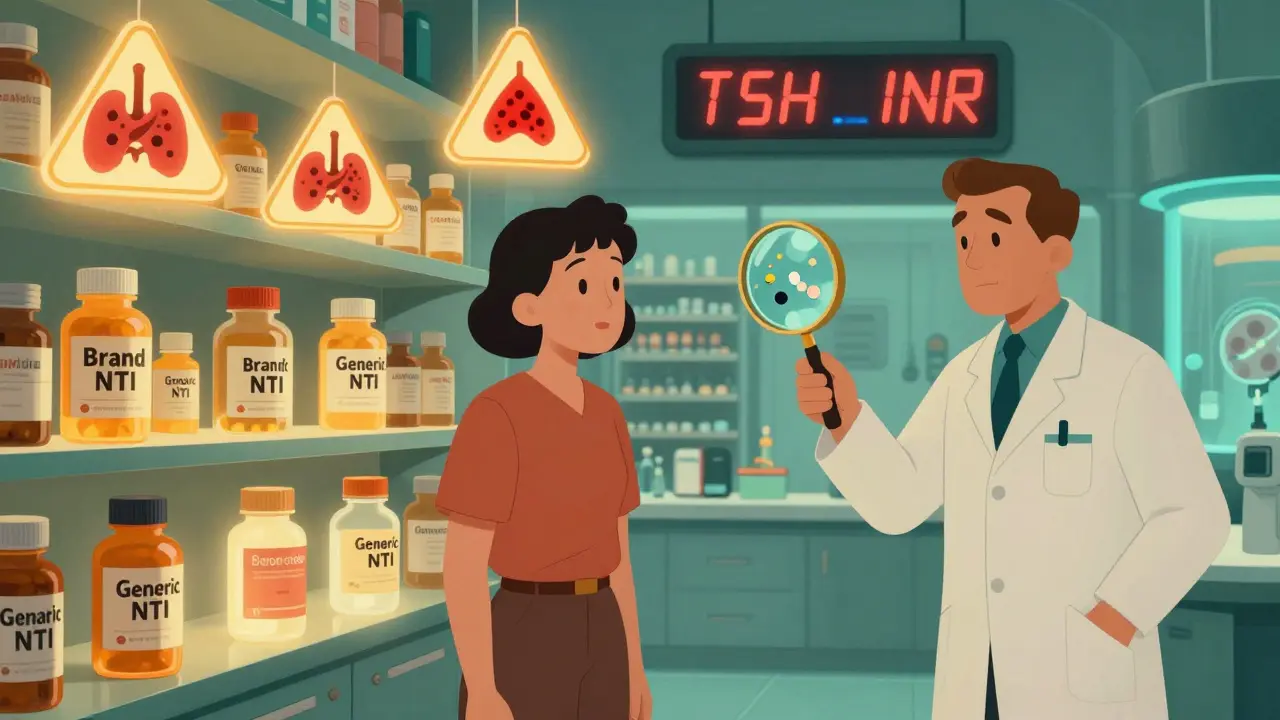
When your doctor prescribes a medication for a serious condition, you expect it to work - every time. But what happens when your pharmacy hands you a generic version of that drug, and you’re told it’s "just as good"? For drugs with a Narrow Therapeutic Index (NTI), that question isn’t just about cost - it’s about safety.
NTI drugs are the kind where even a tiny change in your blood level can mean the difference between treatment working and something going terribly wrong. Too little? Your condition flares up. Too much? You risk serious side effects or even poisoning. These aren’t your everyday painkillers or allergy meds. They’re life-critical drugs like levothyroxine for thyroid disease, warfarin for blood clots, tacrolimus for organ transplant patients, and certain seizure medications. And yes - many of them now have generic versions that cost far less.
What Makes a Drug "Narrow Therapeutic Index"?
The FDA defines NTI drugs as those where small changes in dose or blood concentration can lead to serious therapeutic failures or toxic reactions. That’s not a vague warning - it’s a precise clinical reality. For most drugs, the difference between a helpful dose and a harmful one might be 2 or 3 times. For NTI drugs? Sometimes it’s just 10%.
Take levothyroxine. If you’re taking 100 mcg a day to keep your thyroid in balance, a 5% change in absorption - maybe because of a different filler in the generic pill - could push your TSH levels out of range. That might mean fatigue, weight gain, or worse, heart rhythm problems. Warfarin is even more delicate. A slight spike in blood levels can cause internal bleeding. A dip? You’re at risk for a stroke. There’s no room for guesswork.
That’s why the FDA treats these drugs differently. While most generics must prove they’re within 80-125% of the brand’s absorption (AUC and Cmax), NTI drugs face stricter rules. Since 2014, many have been held to a tighter range - often 90-111%. That’s not just a technical detail. It’s a safety buffer.
Do Generic NTI Drugs Really Work the Same?
The FDA says yes. All approved generics - even for NTI drugs - must meet the same quality, strength, purity, and bioequivalence standards as the brand. And the data backs this up in many cases.
A 2022 study of nearly 18,000 patients on levothyroxine found no meaningful difference in thyroid hormone levels between those taking brand and generic versions. Another study of over 3.5 million patients with chronic conditions like hypertension and diabetes showed similar outcomes with generics. For many people, switching saves money without sacrificing control.
But here’s the catch: not all NTI drugs are created equal. Tacrolimus - used after transplants - has shown inconsistent results in studies. Some patients switch from one generic to another and see their blood levels swing dangerously. That’s why pharmacists often recommend staying on the same manufacturer’s version once you’ve stabilized. Even if it’s generic, consistency matters.
Antiepileptic drugs are another gray zone. Bioequivalence studies say they’re interchangeable. But real-world reports tell a different story. The Epilepsy Foundation’s 2022 survey found 42% of patients reported breakthrough seizures after switching to generics. That’s not proof of failure - it’s a red flag that some people are more sensitive than others.
Cost vs. Risk: The Real Trade-Off
Let’s talk numbers. Brand-name levothyroxine can cost $30-$60 a month. The generic? $4-$15. That’s an 80% savings. For warfarin, switching to generic saves about $3,128 per 100 patients per year. For patients on Medicare or without insurance, that’s life-changing.
But here’s what’s often left out: the hidden costs of switching. If your TSH goes out of range after a generic switch, you might need extra lab tests, a doctor visit, or even an ER trip. That’s not just time and stress - it’s more money.
And if you’re on tacrolimus after a kidney transplant? One bad switch could mean rejection, hospitalization, or a return to dialysis. The cost of that isn’t on a pharmacy receipt - it’s measured in survival.
Insurance companies know this. Many now require prior authorization before covering brand-name NTI drugs. Blue Cross Blue Shield of Kansas, for example, makes patients pay the full difference between generic and brand if they insist on the brand. That pushes people toward generics - but doesn’t eliminate the risk.

When Should You Stick With the Brand?
You don’t need to stay on brand just because it’s brand. But there are clear situations where it makes sense:
- You’ve been stable on a specific product - brand or generic - for months or years. Don’t rock the boat.
- Your condition is life-critical. Think transplant, epilepsy, or anticoagulation therapy.
- You’ve had a bad reaction after switching before - even if it was years ago.
- Your doctor or pharmacist says to stay put.
Some states have laws that require pharmacists to notify your doctor before substituting an NTI drug. Twenty-eight states have some form of non-substitution rule. In Texas, for example, pharmacists can’t switch your levothyroxine without your doctor’s OK. But in others? It happens automatically.
That’s why you need to be proactive. Ask your pharmacist: "Is this the same manufacturer as last time?" If they say "no," ask your doctor if you should stay on what you’re used to.
What You Can Do Right Now
Here’s a simple action plan:
- If you’re new to an NTI drug, start with the generic. It’s safe, effective, and saves money.
- If you’re already stable on a brand or generic, don’t switch unless you have to.
- Always check the label. Note the manufacturer name - even if it says "generic." Different makers can mean different results.
- Get your blood tested 4-8 weeks after any switch. For levothyroxine, that’s TSH. For warfarin, it’s INR. For tacrolimus, it’s whole blood concentration.
- Speak up. Tell your doctor if you feel different after a switch - even if it’s "just a little off."
There’s no one-size-fits-all answer. For many, generics are perfectly safe. For others, even a 5% difference is too much. The key is awareness - not fear.

What’s Changing in 2026?
The FDA launched the NTI Drug Registry in 2023 to track real-world outcomes after substitutions. AHRQ is funding a $2.4 million study tracking 50,000 patients across 15 health systems. By 2025, experts predict most NTI drugs will have enough data to support generic use - except maybe a few with extreme variability, like phenytoin.
But here’s the bottom line: science is catching up to patient experience. The old rule - "always use brand for NTI drugs" - is fading. The new rule? "Match the drug to the patient."
Are all generic NTI drugs the same?
No. While all approved generics must meet FDA bioequivalence standards, they can come from different manufacturers with different inactive ingredients. These can affect how the drug is absorbed. A patient stable on one generic may have problems switching to another, even if both are "AB-rated." That’s why consistency matters - stick with the same manufacturer if possible.
Can I switch from brand to generic without telling my doctor?
Technically, yes - if your state allows automatic substitution. But you shouldn’t. NTI drugs are not like ibuprofen. Even small changes can affect your health. Always consult your prescriber before switching. Some states require pharmacist notification to the doctor, but many don’t. Don’t assume they’re watching.
Why do some doctors refuse to prescribe generics for NTI drugs?
Some doctors have seen patients have adverse events after switching - especially with tacrolimus or antiepileptics. While large studies show equivalence on average, individual variation exists. For patients with complex histories or unstable conditions, the risk of a bad reaction - even if rare - outweighs the cost savings. Many use "dispense as written" to avoid uncertainty.
How do I know if my generic NTI drug is from the same manufacturer?
Check the label on the pill bottle. The manufacturer’s name is usually printed near the bottom. If it changes from one refill to the next, that’s a switch. Ask your pharmacist: "Was this made by the same company as last time?" If not, ask your doctor if you should stay on the original.
Is it safe to switch between different generic versions of the same NTI drug?
It’s risky. Even if both are FDA-approved, switching between different generic manufacturers can cause fluctuations in blood levels. This is especially true for drugs like tacrolimus, warfarin, and phenytoin. Once you’re stable on a specific product - brand or generic - avoid switching unless your doctor advises it and monitors you closely.
Final Thought: Trust Your Body, Not Just the Label
Generic drugs saved millions of people money. For NTI drugs, they’re often safe - but not always. Your body isn’t a lab test. It’s a living system that responds to subtle changes. If you feel different after a switch, don’t brush it off. Talk to your doctor. Get tested. Stay informed. You’re not being paranoid - you’re being smart.
Camille Hall
February 9, 2026 AT 12:02As someone who’s been on levothyroxine for 12 years, I’ve switched between generics and brand so many times I’ve lost count. The only thing that ever mattered? Consistency. Once I found a generic from the same manufacturer that worked, I stuck with it like glue. My TSH has been rock solid for years. Don’t fix what ain’t broke. And yeah, I check the label every time - because I’ve learned the hard way that "generic" doesn’t mean "identical."
Ritteka Goyal
February 10, 2026 AT 18:08Ohhh I love this post!! I’m from India and here generics are EVERYTHING - we don’t even have brand names in most places, and people are fine! My aunt is on warfarin and she’s been on the same generic for 7 years, no issues, no hospital, no drama. Why do Americans act like switching is some kind of nuclear accident? We’ve been doing this since the 90s! Maybe it’s not the drug - maybe it’s the fear? Also, I think FDA rules are too strict for no reason, like they’re scared of their own shadow. I mean, if 18,000 people had no difference, why are we still panicking? #StopOvermedicalizing
Frank Baumann
February 10, 2026 AT 20:26Let’s be real - this whole "NTI generics are safe" narrative is corporate propaganda wrapped in a lab coat. You think the FDA actually tests every single batch? Nah. They rely on manufacturers to self-report. And guess who owns the patents on the original brands? Big Pharma. And guess who owns the generic factories? Big Pharma’s subsidiaries. The same companies. Same factories. Same people. They just slap a different label on it and charge 1/5th the price. The "AB rating"? A joke. I’ve seen patients crash after switching. One guy went into atrial fibrillation because his tacrolimus levels spiked. He didn’t switch manufacturers - he switched batches. And the pharmacy? They didn’t even tell him. That’s not science. That’s roulette with your life.
And don’t get me started on the "28 states have rules" thing. That’s just window dressing. Most pharmacists don’t even know the rules. They’re trained to maximize turnover, not patient safety. And if you’re on Medicare? Good luck getting prior auth. They’ll deny it, then blame you for the ER visit. This isn’t about cost - it’s about profit. And we’re the guinea pigs.
Kathryn Lenn
February 12, 2026 AT 15:58Wow. So the FDA says generics are fine, but then they make you jump through hoops to get the brand? And doctors say "don’t switch" but insurance won’t pay? And the label changes every month but no one tells you?
So what you’re saying is… we’re all just lab rats in a corporate experiment, and the only thing keeping us alive is reading tiny print on a pill bottle?
Yup. Welcome to 2024. I’m just waiting for the government to start charging us per heartbeat.
Angie Datuin
February 14, 2026 AT 14:10This is such an important topic. I work as a med-surg nurse and I’ve seen too many patients panic after a switch - not because they’re paranoid, but because they *feel* different. Fatigue, brain fog, palpitations. And when they go to the doctor, the lab numbers look "fine." But their body says otherwise. I always tell them: trust your body. If something feels off, speak up. Even if the numbers say you’re okay. Your symptoms matter too.
Sam Dickison
February 16, 2026 AT 05:19From a clinical pharmacology standpoint, the 90-111% AUC/Cmax range for NTI drugs isn’t arbitrary - it’s based on population PK/PD modeling and real-world variability in absorption. The key is that bioequivalence is population-level, not individual. So while the group mean may be stable, some patients are outliers due to genetics, GI motility, or even gut microbiome differences. That’s why the recommendation to avoid switching once stabilized isn’t just caution - it’s evidence-based. Also, inactive ingredients matter more than people think. Lactose, dyes, fillers - they can alter dissolution rates in the duodenum. It’s not magic. It’s pharmacokinetics.
Joseph Charles Colin
February 17, 2026 AT 01:26As a transplant pharmacist, I’ve managed over 200 tacrolimus patients. The data is clear: switching between generics increases the risk of rejection by 3.7x in the first 6 months. Not because the drug is bad - because the absorption profile shifts. One patient went from 8.2 ng/mL to 15.6 ng/mL after switching from Mylan to Teva. She had tremors, hypertension, and renal toxicity. We had to admit her. That’s not a fluke - it’s systemic. We now have a policy: once a patient is stable on a specific generic (or brand), we lock it in. No switches. No exceptions. Even if it costs $50 more a month. Survival > savings. Period.
Also - check the lot number. If it changes, it’s a different manufacturer. Ask for the invoice. Most pharmacies won’t give it to you, but if you push, they’ll have to. Knowledge is power.
Joshua Smith
February 18, 2026 AT 01:08Just wanted to say thanks for writing this. I’m on warfarin and switched to generic last year. My INR was stable for months, then suddenly spiked after a refill. Turns out the manufacturer changed. I didn’t know until I checked the bottle. Now I keep a little notebook: date, manufacturer, INR. It’s a pain, but it’s saved me from a stroke. Small steps, big differences.